Bloggers Last updated February 23, 2026

How to Track Bounce Rate for Bloggers

Your bounce rate reveals key insights. Learn what causes issues, what good looks like, and how to fix it with real data.

How to Track Bounce Rate for Bloggers

You just published your latest blog post. You checked your analytics expecting to see engaged readers, but nearly 65% of visitors left after viewing just one page. If this sounds familiar, you’re not alone. Understanding bounce rate helps you keep readers on your blog longer.

Why Bounce Rate Matters for Bloggers

Bounce rate shows the percentage of visitors who leave after viewing only one page. For bloggers, this metric directly impacts your revenue and growth.

What this means for your wallet:

  • Readers who bounce don’t see your ads, affiliate links, or product recommendations
  • High bounce rates signal to advertisers that your traffic isn’t valuable
  • Each bounce represents a lost opportunity to build an email subscriber or loyal reader

A blogger earning $500 per month from display ads could potentially double that income by reducing bounce rate from 70% to 45%.

What Causes Bloggers Issues with Bounce Rate

Several factors hurt blogger bounce rates:

Slow loading times drive visitors away before content even loads. Images that aren’t optimized or heavy plugins create lag.

Mismatch between title and content frustrates readers who expect one thing but get another. Clickbait headlines backfire quickly.

Poor mobile experience causes bounces since most blog traffic comes from phones. Tiny text, broken layouts, or hard-to-tap links frustrate mobile readers.

No clear next step leaves visitors wondering what to do next. Without internal links or CTAs, they simply leave.

Thin or low-quality content fails to keep readers engaged. Visitors quickly sense when content lacks depth or value.

How to Track It

Here’s how to monitor bounce rate using Google Analytics 4 and ClawAnalytics:

In Google Analytics 4:

  1. Open GA4 and go to Reports
  2. Select Life Cycle > Engagement > Pages and screens
  3. Look at the “Bounce rate” column for each URL
  4. Set a comparison to see how specific pages perform

Ask ClawAnalytics questions like:

  • “Which blog posts have the highest bounce rate this month?”
  • “What’s the average bounce rate for articles over 1500 words?”
  • “Do posts with images have lower bounce rates than posts without?”

ClawAnalytics makes it simple to spot trends across your entire blog without manually checking each page. You can also track bounce rate by traffic source to see if visitors from social media bounce more than search visitors.

Quick Wins

  1. Add a related posts section at the bottom of each article to keep readers exploring your blog.

  2. Optimize your opening paragraph to hook readers in the first 3 seconds. Front-load value and don’t bury the main point.

  3. Break up long content with subheadings, bullet points, and images. Walls of text scare readers away.

  4. Test your page speed using PageSpeed Insights and compress any images over 100KB.
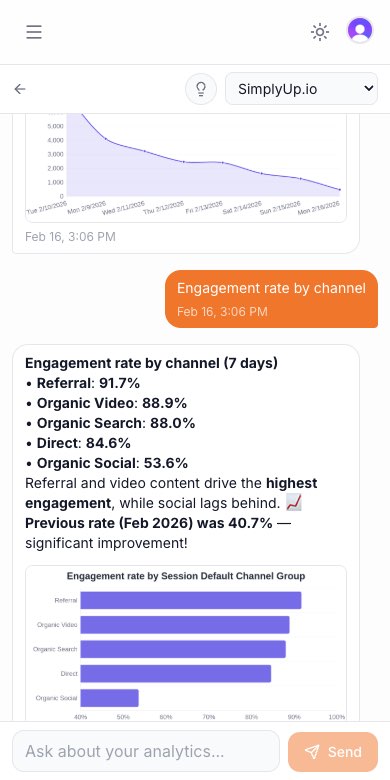
Check your analytics from anywhere

On your morning commute. At a coffee shop. In a meeting. Pull up your analytics on any device and get instant answers.

  • Web dashboard on desktop & mobile
  • Discord bot for team channels
  • Slack integration for your workspace
  • MCP server for AI agents (Claude, Cursor)
See your traffic in 60 seconds →
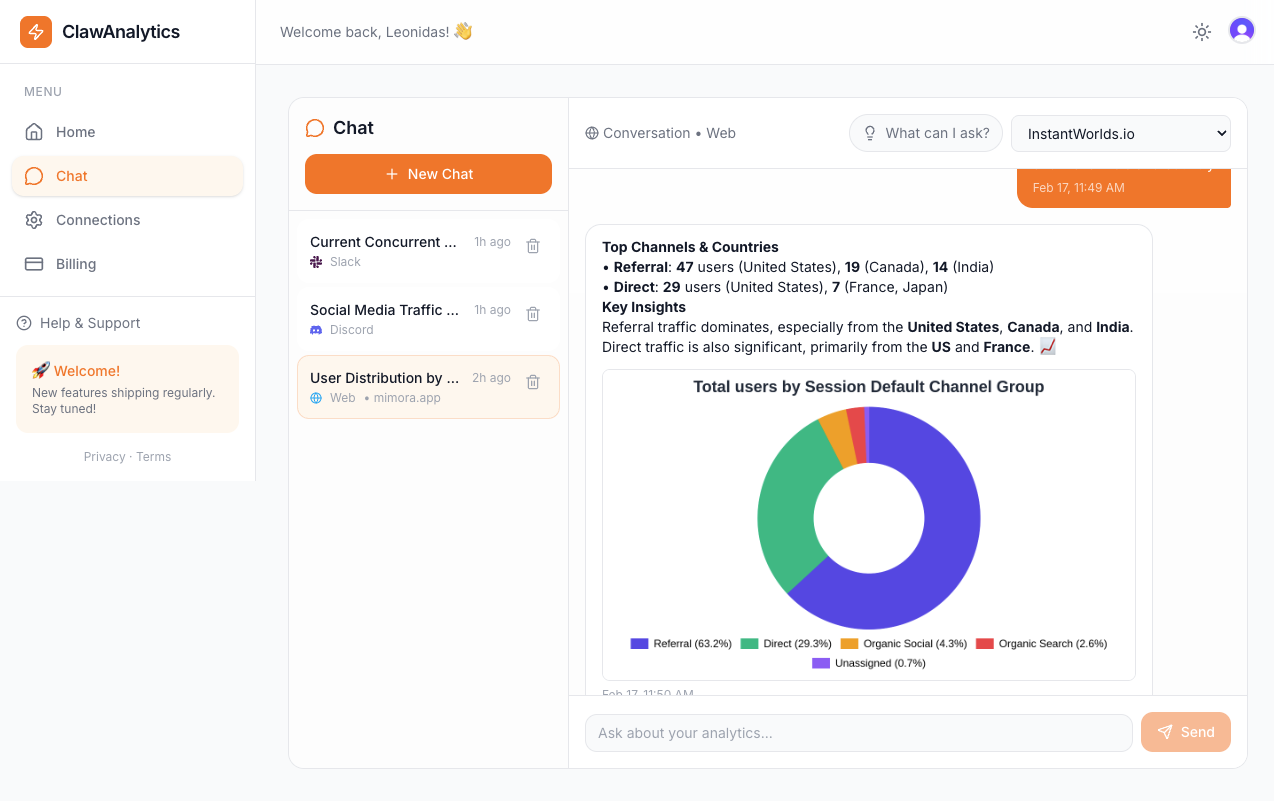
ClawAnalytics mobile chat showing engagement rate breakdown with charts

How ClawAnalytics helps

Skip the dashboards. Get answers in seconds.

🔗
1

Connect GA4

One-click OAuth. Read-only access. Takes 30 seconds to link your Google Analytics property.

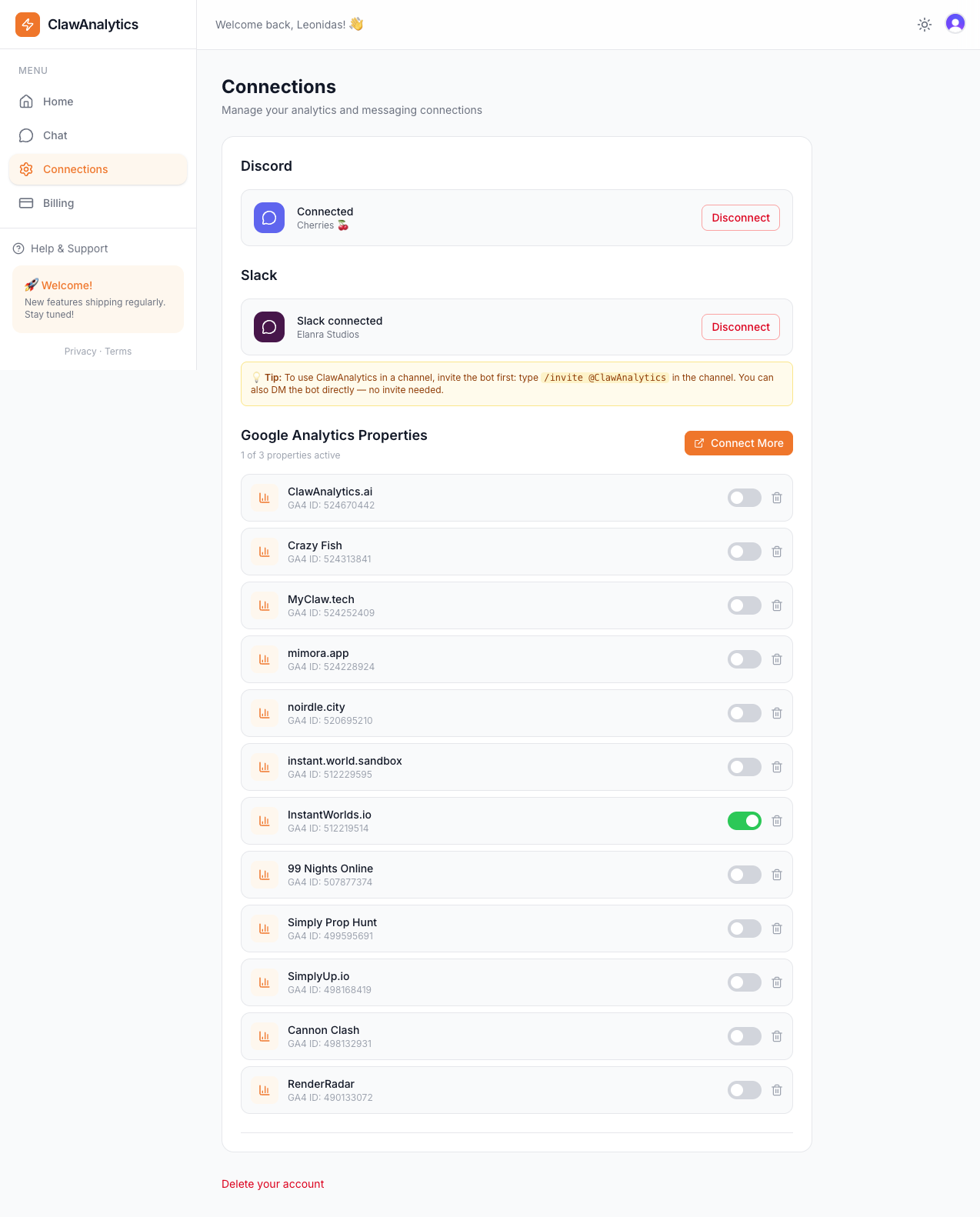
ClawAnalytics connections page showing Google Analytics properties linked
💬
2

Ask questions

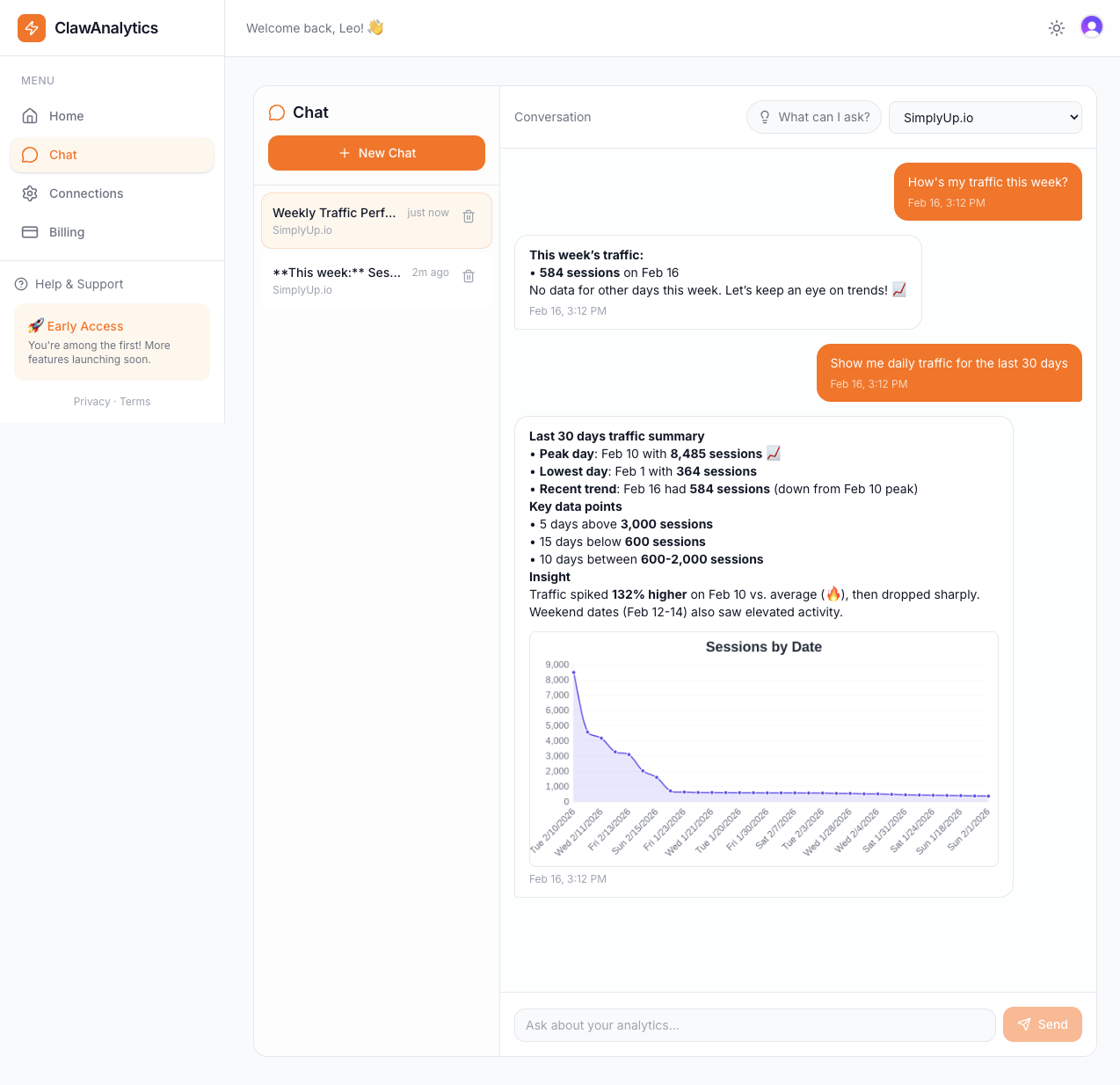
Type in plain English. No query language, no filters, no date pickers. Just ask what you want to know.

ClawAnalytics chat interface with natural language query
📊
3

Get answers with charts

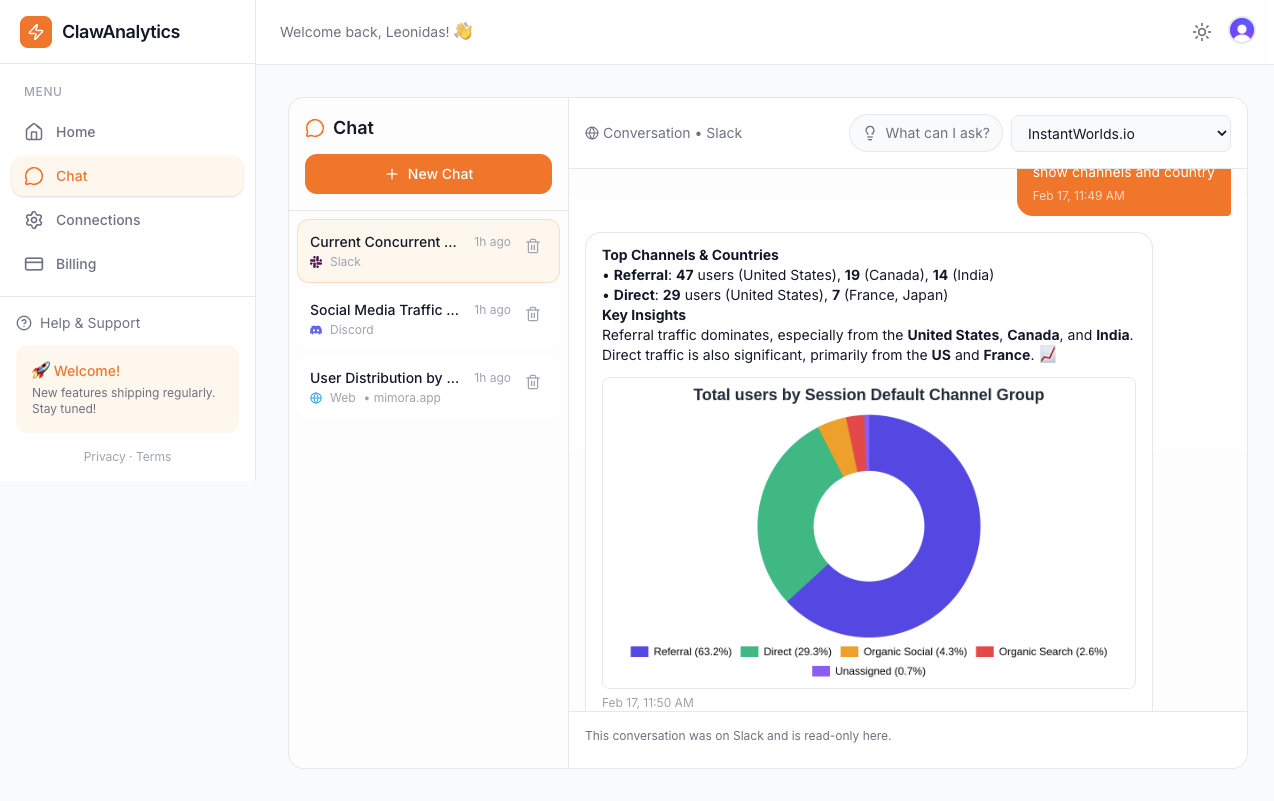
Instant responses with visualizations. Share charts with your team or export the data.

ClawAnalytics showing chart response to analytics query

See it in action

Ask a question. Get a chart. That simple.

ClawAnalytics Chat
ClawAnalytics chat interface showing a natural language analytics query with chart response

Works on web, Discord, and Slack. Also available as an MCP server for AI agents.

Leonidas Maliokas
"I used to open Google Analytics 5 times a day and still miss things. Now I get a summary every morning and ask follow-ups when something looks off. Takes 10 seconds instead of 10 minutes."

Leonidas Maliokas

Founder, Elanra Studios

🎮 5 games monitored 💼 3 businesses

Simple, honest pricing

Start free. Upgrade when you're ready.

Free

Try it out

$0 /month
  • 5 websites
  • 30 questions/month
  • Web dashboard
  • No credit card
Start Free

Website

For small businesses

$9 /month
  • 5 websites connected
  • 100 questions/month
  • Daily morning summary
  • Web dashboard + Discord
Get Started

Business

For agencies and portfolios

$79 /month
  • Unlimited websites
  • 2,000 questions/month
  • Everything in Pro
  • ✅ API access
  • ✅ MCP integration
  • ⭐ Priority support
Get Started

Stop opening dashboards.
Start asking.

Connect Google Analytics in 30 seconds. Get answers from the dashboard or Discord. Start free — no credit card needed.

Try it free — ask your first question
30-second setup Free plan available Cancel anytime

Got questions?

What is a good bounce rate for bloggers?
A good bounce rate for bloggers typically ranges between 40% and 70%. If your blog focuses on informational content, aim for the lower end around 40-50%. Entertainment blogs can tolerate rates closer to 60-70%.
Why do readers leave my blog posts without reading more?
Readers often bounce when page load times are slow, the content doesn't match search intent, or headlines oversell the article. Mobile users are especially prone to bouncing if the site isn't mobile-friendly.
How can I reduce bounce rate on my blog?
Add internal links to related posts, include a table of contents for long articles, and add images to break up text. Consider adding a newsletter signup that appears after reading a few paragraphs.
Does bounce rate affect my Google rankings?
Bounce rate isn't a direct Google ranking factor, but high bounce rates may signal to Google that your content isn't satisfying user intent, which can indirectly impact rankings over time.

Related guides

More resources to help you get the most from your analytics.