Dentists

How to Track Channel Grouping for Dentists

Learn how to track channel grouping for dentists to understand which marketing sources bring in the most patients.

How to Track Channel Grouping for Dentists

Dental practices live or die by patient flow. You might spend money on ads, search optimization, and local partnerships. But do you know which actually brings new patients? Channel grouping makes this clear.

Why Channel Grouping Matters for Dentists

1. New patient tracking. Every dental practice needs new patients. Channel grouping shows which sources bring them. You stop guessing and start optimizing.

2. Insurance versus cash patients. Some sources bring patients with certain insurance plans. Others bring those paying out of pocket. Grouping reveals these patterns. You understand your patient mix.

3. Recall appointment success. Dental practices rely on recall visits. When you send reminders, do they work? Channel grouping shows which channels bring patients back for cleanings and checkups.

4. Treatment case acquisition. A routine cleaning is different from a crown or implant. Channel grouping helps you understand which sources bring higher-value cases. You focus on what grows your practice.

How to Check in GA4

Open GA4 and go to Traffic Acquisition. The default Channel grouping shows Organic Search, Paid Search, Social, Email, Referral, and Direct. This gives you the big picture.

For a dental practice, create custom channel groups. Go to Configure > Channel definitions > Channel groups. Separate local search from broader terms. Group insurance partnership traffic. Track your online booking separately.

Always use UTM parameters. When you run a campaign about teeth whitening, tag it. When you partner with a local business, track the link. Consistent tagging is essential.

Track appointment bookings as conversions. A visitor who schedules is more valuable than one who just looks at your services. Set this up in GA4 or let ClawAnalytics handle it.

The Easier Way

You became a dentist to help patients, not to decode analytics. ClawAnalytics makes tracking simple.

ClawAnalytics connects to your practice data and shows you which channels bring patients who book and keep appointments. You get clear insights without the complexity of raw GA4.

For example, you might discover that your Google Business Profile brings most new patients. Or that your email recall reminders are driving more return visits than any other channel. These insights help you allocate your marketing budget wisely.

ClawAnalytics also helps you understand no-show patterns. You see which channels bring patients who actually show up versus those who book but cancel.

Quick Wins

Start with basic channels. See where your website traffic comes from. Does this match your marketing efforts?

Tag every campaign. Google Ads, Facebook posts, local partnerships. Everything needs UTM tags.

Track appointments. Set up conversion tracking for booking confirmations. This is the most important metric.

Watch local search. Most dental patients come from nearby. Focus on local SEO and Google Business Profile.

Encourage reviews. Online reviews drive new patients. Track how many mention finding you through reviews.
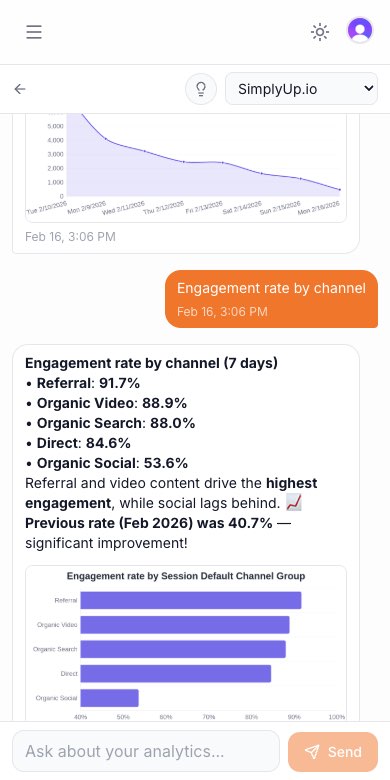
Check your analytics from anywhere

On your morning commute. At a coffee shop. In a meeting. Pull up your analytics on any device and get instant answers.

  • Web dashboard on desktop & mobile
  • Discord bot for team channels
  • Slack integration for your workspace
  • MCP server for AI agents (Claude, Cursor)
See your traffic in 60 seconds →
ClawAnalytics mobile chat showing engagement rate breakdown with charts

How ClawAnalytics helps

Skip the dashboards. Get answers in seconds.

🔗
1

Connect GA4

One-click OAuth. Read-only access. Takes 30 seconds to link your Google Analytics property.

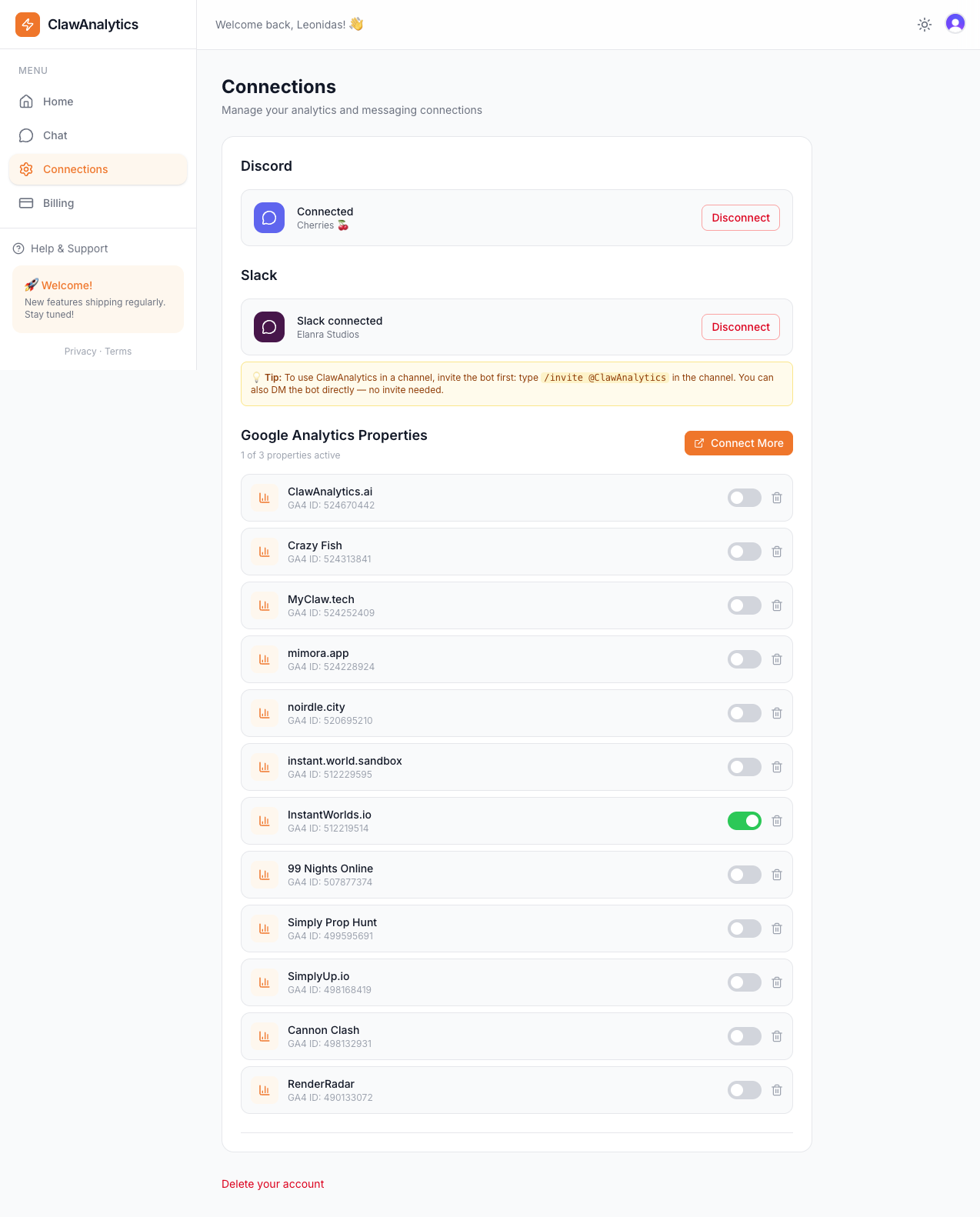
ClawAnalytics connections page showing Google Analytics properties linked
💬
2

Ask questions

Type in plain English. No query language, no filters, no date pickers. Just ask what you want to know.

ClawAnalytics chat interface with natural language query
📊
3

Get answers with charts

Instant responses with visualizations. Share charts with your team or export the data.

ClawAnalytics showing chart response to analytics query

See it in action

Ask a question. Get a chart. That simple.

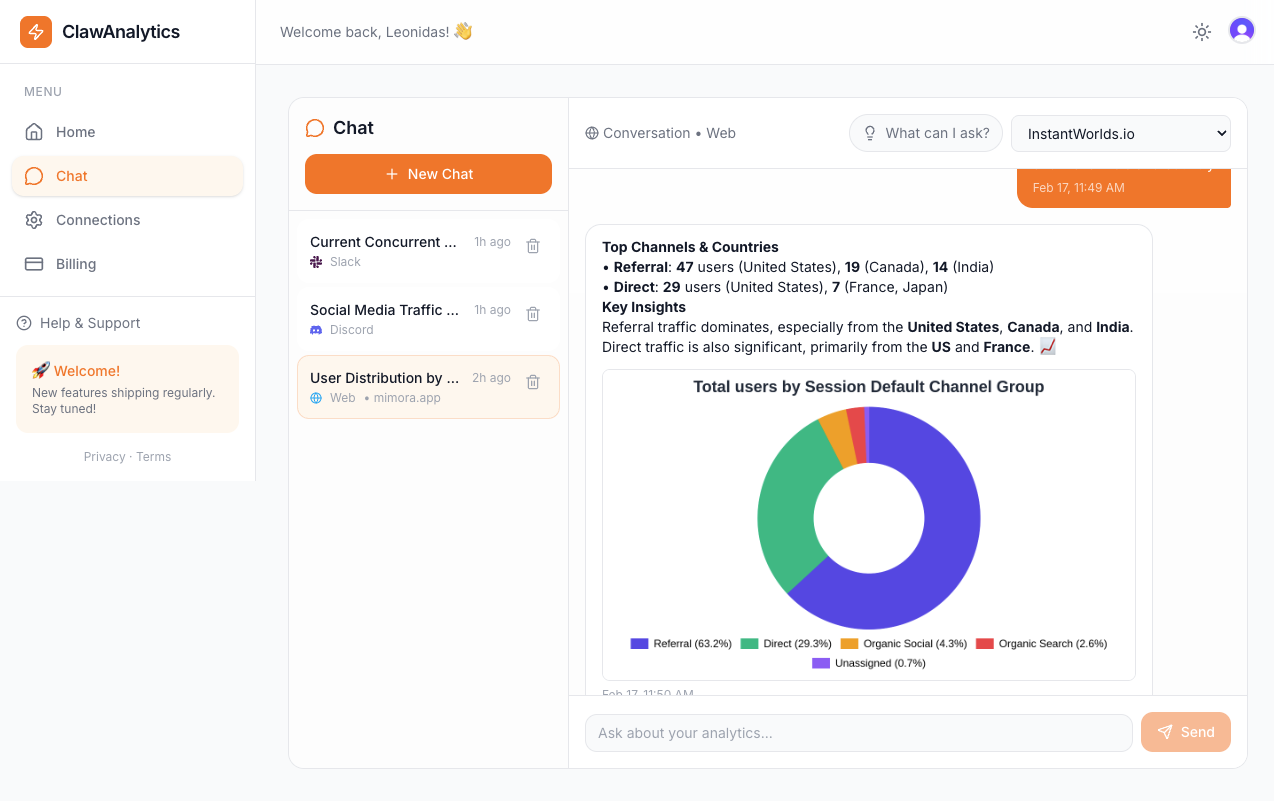
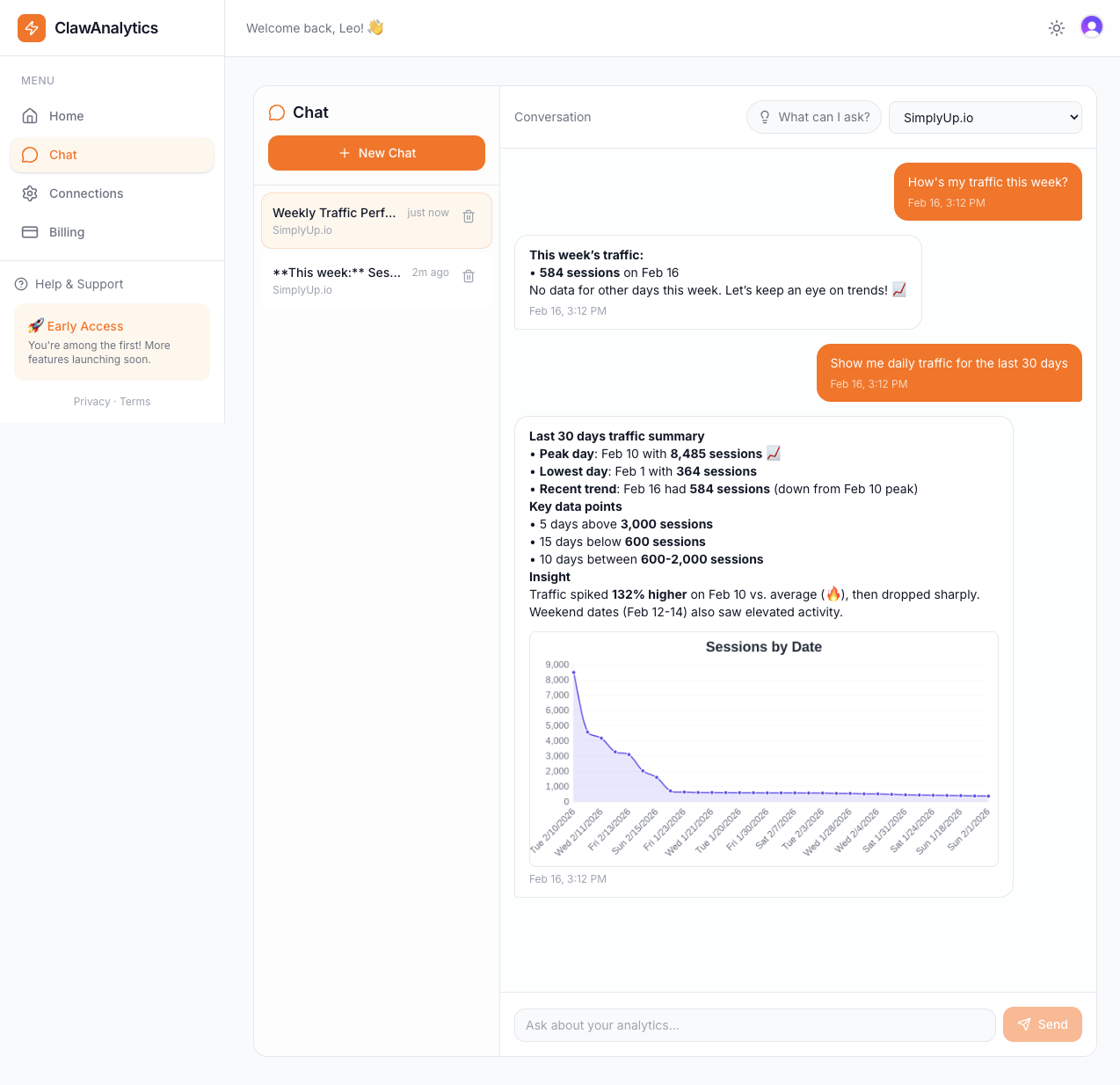
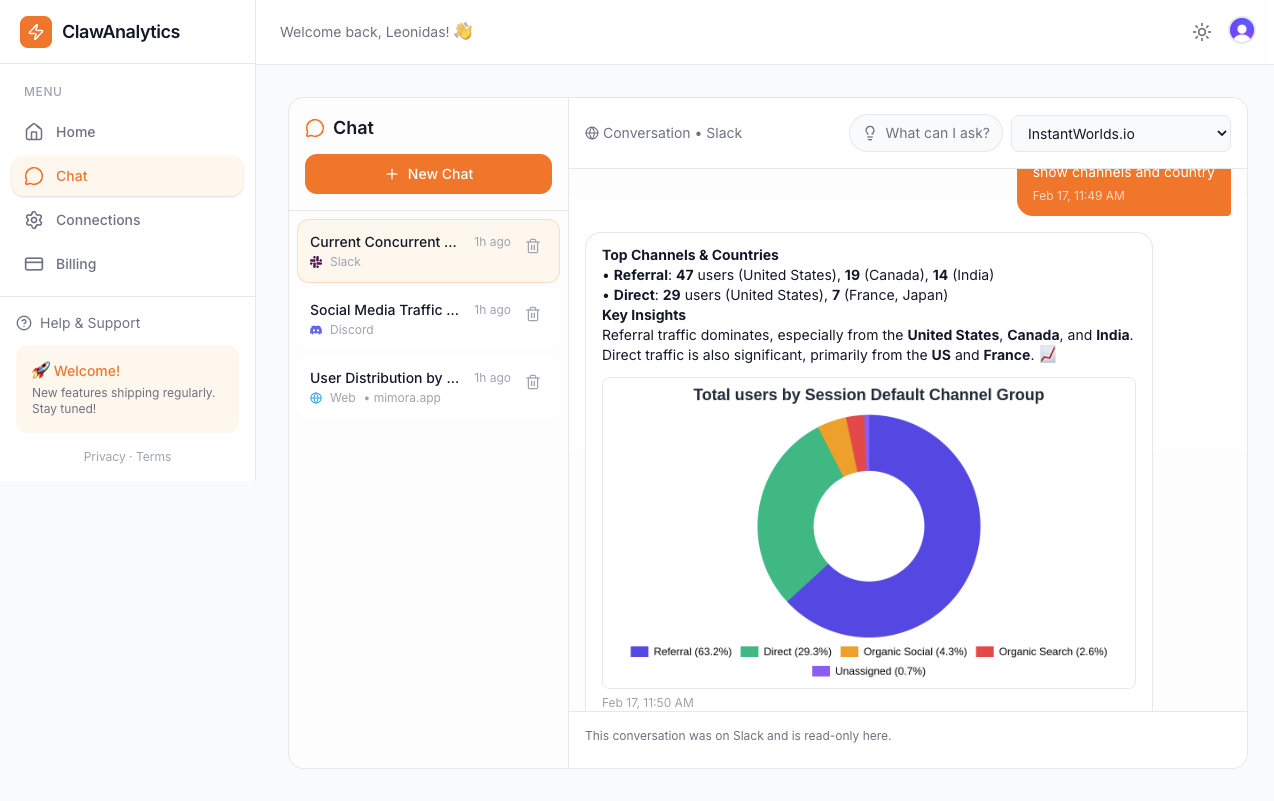
ClawAnalytics Chat
ClawAnalytics chat interface showing a natural language analytics query with chart response

Works on web, Discord, and Slack. Also available as an MCP server for AI agents.

Leonidas Maliokas
"I used to open Google Analytics 5 times a day and still miss things. Now I get a summary every morning and ask follow-ups when something looks off. Takes 10 seconds instead of 10 minutes."

Leonidas Maliokas

Founder, Elanra Studios

🎮 5 games monitored 💼 3 businesses

Simple, honest pricing

Start free. Upgrade when you're ready.

Free

Try it out

$0 /month
  • 5 websites
  • 30 questions/month
  • Web dashboard
  • No credit card
Start Free

Website

For small businesses

$9 /month
  • 5 websites connected
  • 100 questions/month
  • Daily morning summary
  • Web dashboard + Discord
Get Started

Business

For agencies and portfolios

$79 /month
  • Unlimited websites
  • 2,000 questions/month
  • Everything in Pro
  • ✅ API access
  • ✅ MCP integration
  • ⭐ Priority support
Get Started

Stop opening dashboards.
Start asking.

Connect Google Analytics in 30 seconds. Get answers from the dashboard or Discord. Start free — no credit card needed.

Try it free — ask your first question
30-second setup Free plan available Cancel anytime

Got questions?

Why is channel grouping important for dental practices?
Dental practices need a steady stream of new patients and loyal returning clients. Channel grouping shows which sources bring both.
How do I set up channel groupings in GA4 for a dental practice?
In GA4, go to Configure > Channel definitions > Channel groups. Create groups for local search, insurance partnerships, referrals, and online booking.
Which channels work best for dental marketing?
ClawAnalytics reveals which channels bring patients who book and show up. You might find that local search drives new patients while email brings recall visits.

Related guides

More resources to help you get the most from your analytics.