Ecommerce Last updated February 23, 2026

How to Track Conversion Rate for Ecommerce

Your ecommerce conversion rate reveals key insights. Learn what causes issues, what good looks like, and how to fix it with real data.

You just launched your online store. You are running ads, optimizing product pages, and checking your analytics daily. But the sales are not coming.

That is the moment when most ecommerce owners panic and start tweaking everything at once. Before you do that, let us look at what your conversion rate is actually telling you.

Why Conversion Rate Matters for Ecommerce

Your conversion rate is the percentage of visitors who complete a purchase. It is the clearest signal of whether your store is working.

Here is the math. If 10,000 visitors land on your site and 300 buy, your conversion rate is 3%. That equals 300 sales. Now imagine you optimize your site and lift that to 4%. You just gained 100 extra sales without spending another dollar on ads.

At scale, even a 1% improvement matters. A store making $50,000 monthly at 2% conversion would add $25,000 in revenue by reaching 3%.

What Causes Ecommerce Issues with Conversion Rate

Poor product page design. Visitors cannot find key information like sizing, materials, or shipping times. They leave.

Slow loading pages. A 1-second delay drops conversions by 7%. Mobile users abandon sites that take more than 3 seconds.

Weak product images. Low-resolution photos or missing zoom functionality make customers hesitate. They cannot see what they are buying.

Complicated checkout. Extra form fields, no guest checkout option, and hidden fees at the last step all increase cart abandonment.

Wrong targeting. If your ads promise one thing and your landing page delivers another, visitors bounce immediately.

How to Track It

In Google Analytics 4, go to Reports, then click on Acquisition. Select Traffic Acquisition and add “Conversions” as a metric. Filter by “Ecommerce” to see purchase-specific data.

ClawAnalytics makes this easier. You can ask questions like “What is my conversion rate by product category?” or “Which traffic source brings buyers who spend the most?” The tool breaks down your data without requiring you to build custom reports.

Set up a dashboard that tracks three things: overall conversion rate, conversion rate by traffic source, and conversion rate by device type. Check these weekly to spot trends early.

Quick Wins

  1. Add trust badges near checkout. SSL seals, payment icons, and return policy links reduce hesitation.
  2. Simplify your forms. Remove optional fields. Ask only for what you need to fulfill the order.
  3. Optimize for mobile. Over 60% of ecommerce traffic comes from phones. Test your checkout flow on actual devices.
  4. Show related products. Suggest complementary items after a purchase or during checkout to increase average order value.
  5. Retarget abandoners. Set up ads for visitors who added items to cart but did not check out. This recovers 10-15% of lost sales.
Check your analytics from anywhere

On your morning commute. At a coffee shop. In a meeting. Pull up your analytics on any device and get instant answers.

  • Web dashboard on desktop & mobile
  • Discord bot for team channels
  • Slack integration for your workspace
  • MCP server for AI agents (Claude, Cursor)
See your traffic in 60 seconds →
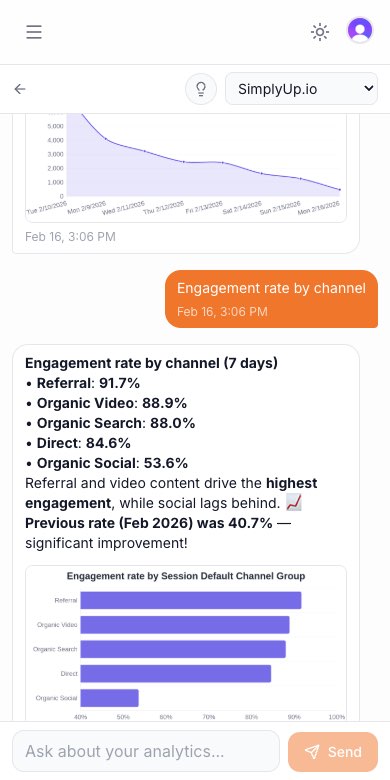
ClawAnalytics mobile chat showing engagement rate breakdown with charts

How ClawAnalytics helps

Skip the dashboards. Get answers in seconds.

🔗
1

Connect GA4

One-click OAuth. Read-only access. Takes 30 seconds to link your Google Analytics property.

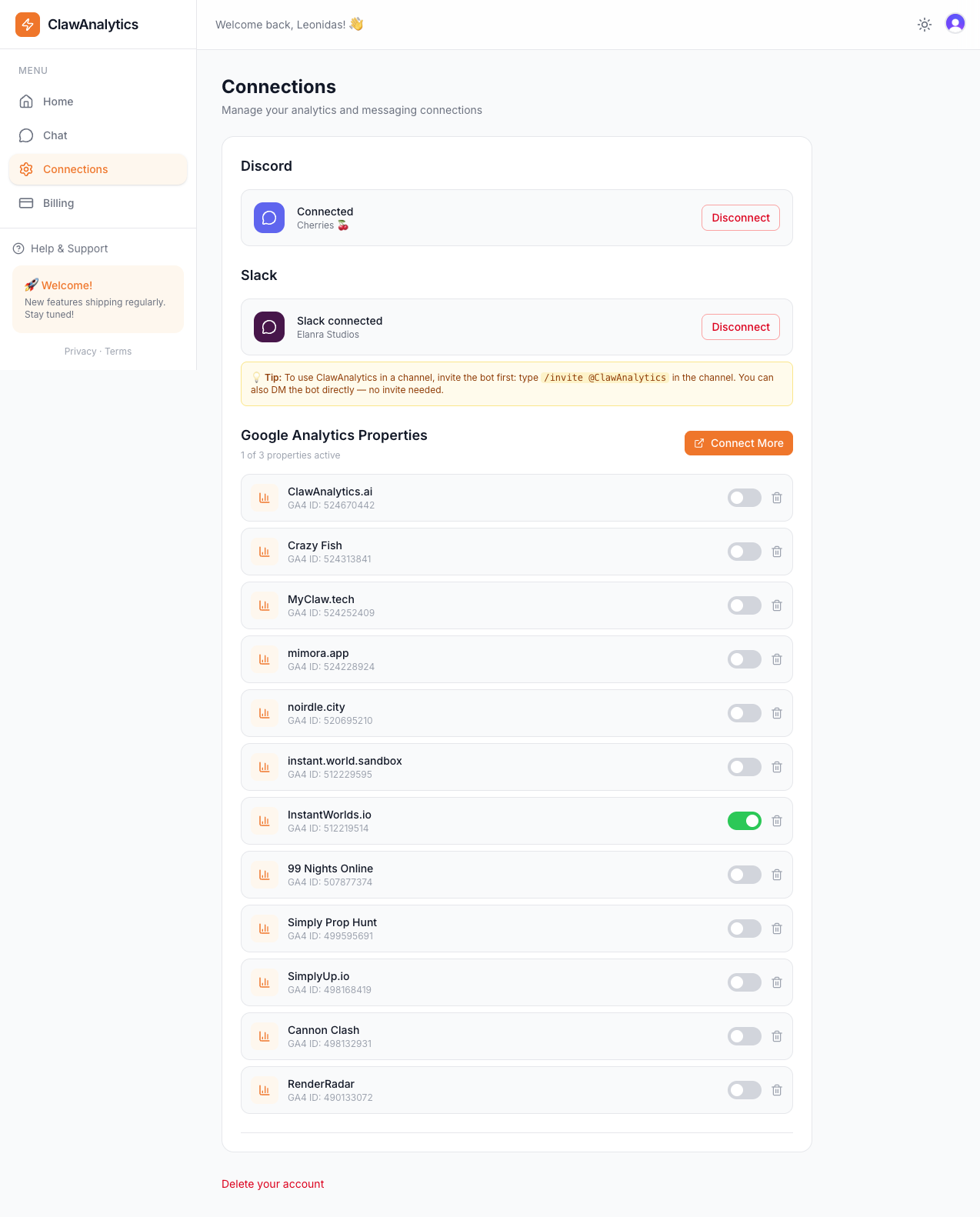
ClawAnalytics connections page showing Google Analytics properties linked
💬
2

Ask questions

Type in plain English. No query language, no filters, no date pickers. Just ask what you want to know.

ClawAnalytics chat interface with natural language query
📊
3

Get answers with charts

Instant responses with visualizations. Share charts with your team or export the data.

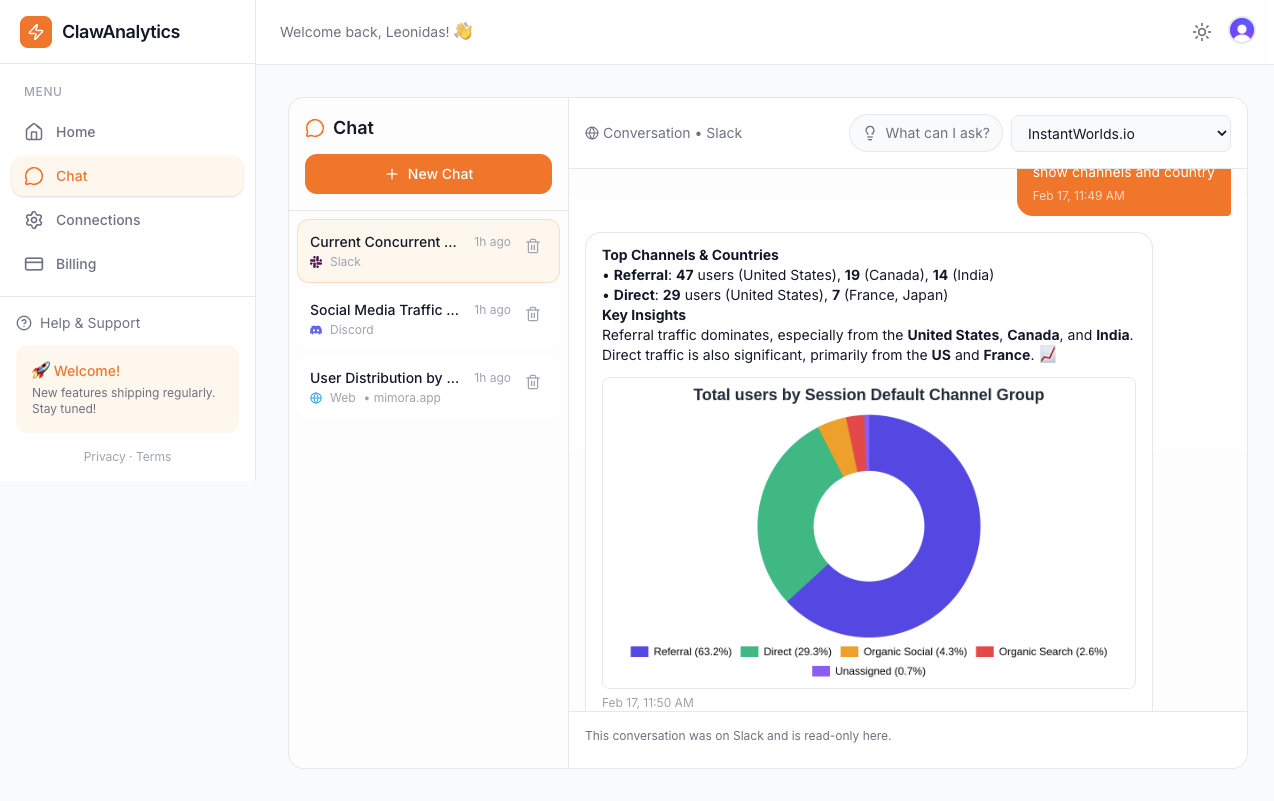
ClawAnalytics showing chart response to analytics query

See it in action

Ask a question. Get a chart. That simple.

ClawAnalytics Chat
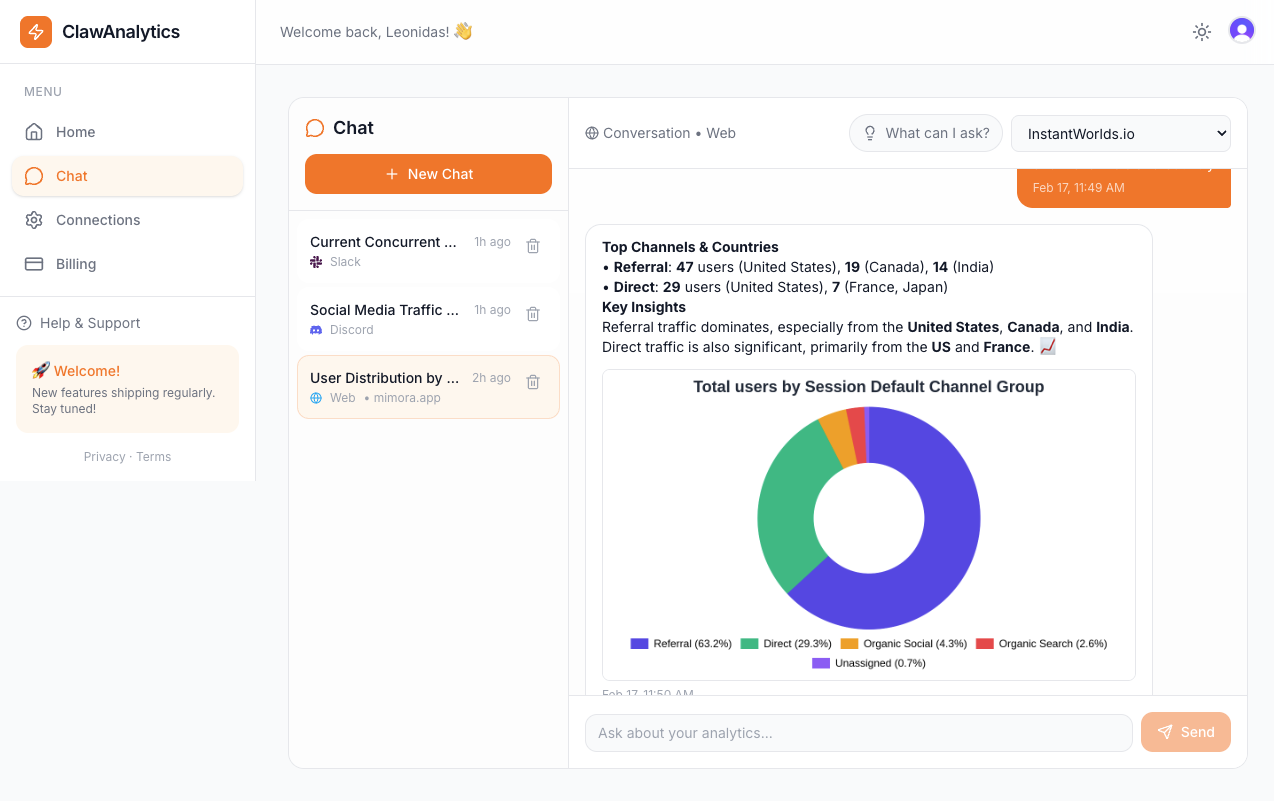
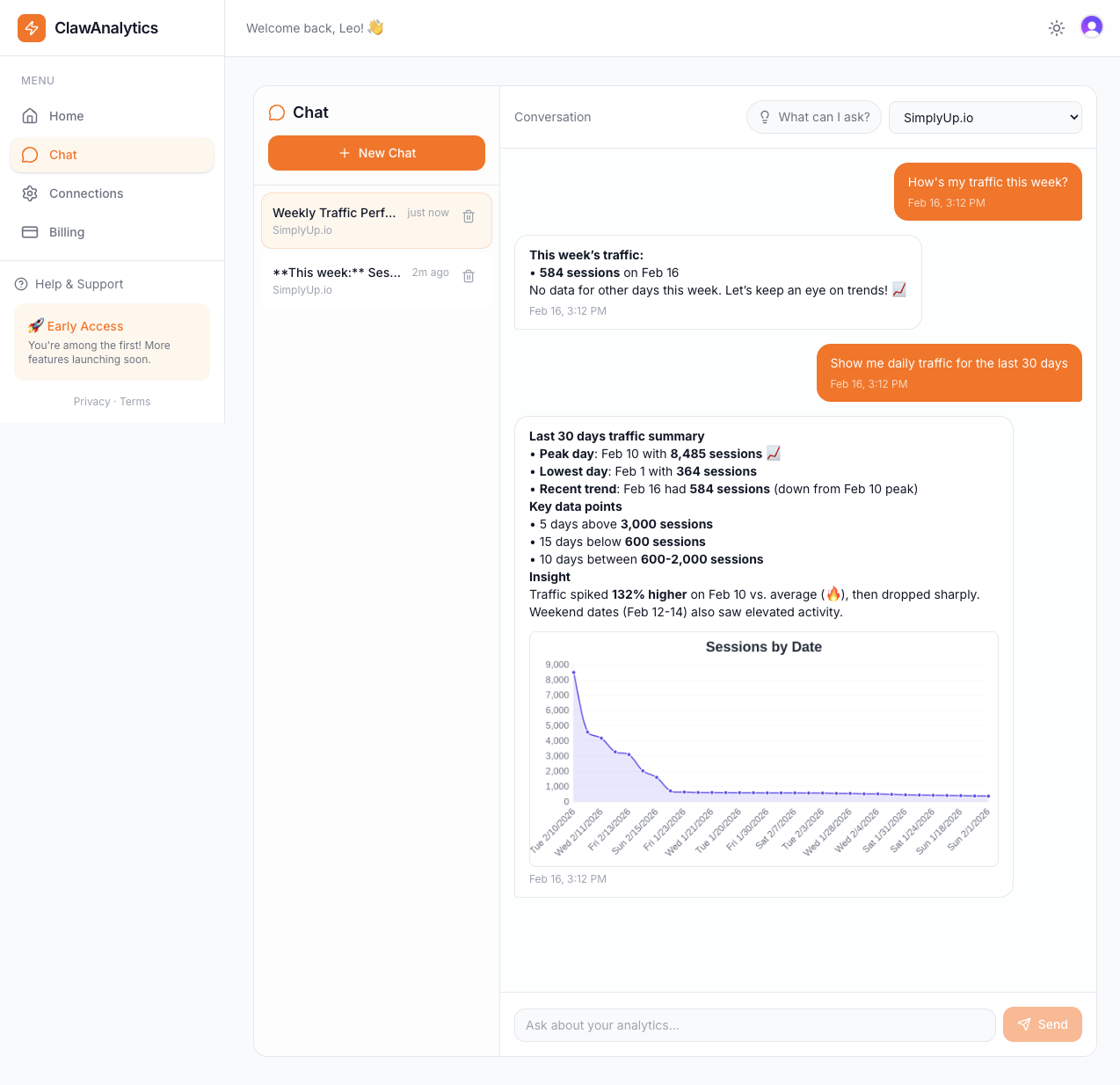
ClawAnalytics chat interface showing a natural language analytics query with chart response

Works on web, Discord, and Slack. Also available as an MCP server for AI agents.

Leonidas Maliokas
"I used to open Google Analytics 5 times a day and still miss things. Now I get a summary every morning and ask follow-ups when something looks off. Takes 10 seconds instead of 10 minutes."

Leonidas Maliokas

Founder, Elanra Studios

🎮 5 games monitored 💼 3 businesses

Simple, honest pricing

Start free. Upgrade when you're ready.

Free

Try it out

$0 /month
  • 5 websites
  • 30 questions/month
  • Web dashboard
  • No credit card
Start Free

Website

For small businesses

$9 /month
  • 5 websites connected
  • 100 questions/month
  • Daily morning summary
  • Web dashboard + Discord
Get Started

Business

For agencies and portfolios

$79 /month
  • Unlimited websites
  • 2,000 questions/month
  • Everything in Pro
  • ✅ API access
  • ✅ MCP integration
  • ⭐ Priority support
Get Started

Stop opening dashboards.
Start asking.

Connect Google Analytics in 30 seconds. Get answers from the dashboard or Discord. Start free — no credit card needed.

Try it free — ask your first question
30-second setup Free plan available Cancel anytime

Got questions?

What is a good conversion rate for Ecommerce?
A healthy ecommerce conversion rate falls between 2-3%. Top performers can reach 3-5%, while anything below 1% signals serious issues with your funnel.
How does traffic quality affect ecommerce conversions?
Targeted traffic from paid ads or organic search converts 3x better than generic social media traffic. If visitors land on irrelevant pages, they leave without buying.
Which pages kill ecommerce conversions?
Your checkout page is the biggest culprit. Unexpected shipping costs, complex forms, and lack of payment options cause 67% of cart abandonments.
Should I track conversion rate by traffic source?
Absolutely. Email traffic often converts at 4-5%, while social media might struggle at 0.5%. Splitting your data by source reveals where to invest your budget.

Related guides

More resources to help you get the most from your analytics.