How to Track Customer Lifetime Value for Saas
In the world of SaaS, there’s one metric that rules them all: customer lifetime value. Why? Because SaaS is fundamentally about subscription revenue over time. A customer who pays $99/month for 3 years is worth $3,564. A customer who churns after 3 months is worth just $297. Understanding this difference isn’t optional. It’s the foundation of sustainable SaaS growth.
Why Customer Lifetime Value Matters for SaaS
CLV is the compass that guides every SaaS decision:
Unit economics depend on it. If your CLV is $5,000 and customer acquisition costs $2,000, you’re in great shape. If CLV drops to $1,500, you’re losing money on every new customer. This ratio drives everything.
Churn becomes actionable. CLV naturally incorporates churn. When you improve retention by 1%, CLV increases significantly. Watching CLV tells you if your churn efforts are working.
Expansion revenue appears. Upsells, cross-sells, and seat expansions all increase CLV. Tracking it reveals expansion opportunities worth pursuing.
Investor readiness. Any SaaS founder knows: investors ask about CLV, CAC, and the ratio between them. Having clean data here builds credibility.
How to Check in GA4
Setting up CLV tracking in GA4 for SaaS:
-
Track subscription events. Use GA4 events for subscribe, subscription_renewal, and subscription_cancel.
-
Create revenue metrics. Set up calculated metrics for Average Revenue Per User (ARPU) across different timeframes (7-day, 30-day, monthly).
-
Calculate churn rate. Churn = (Customers Lost This Month) / (Total Customers at Start). CLV = ARPU / Churn Rate.
-
Build cohort reports. Track how different signup cohorts retain and generate revenue over time.
-
Segment by plan type. Compare CLV across Free, Starter, Pro, and Enterprise tiers.
The Easier Way
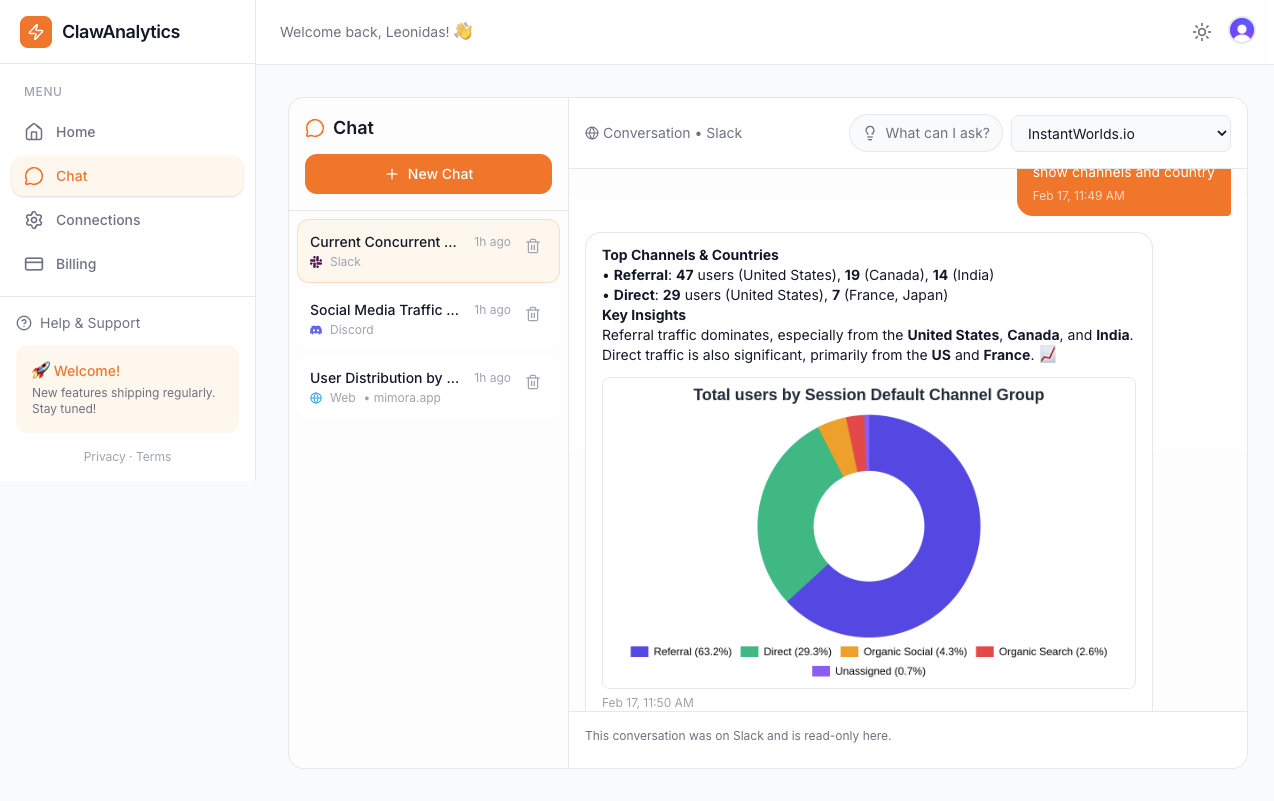
ClawAnalytics makes SaaS CLV tracking straightforward and immediately useful.
Instead of building complex calculations, ClawAnalytics tells you:
- Which user behaviors most strongly predict high CLV (feature usage patterns, onboarding completion, support ticket frequency)
- How CLV differs between customer segments (by industry, company size, acquisition source)
- When customers are at highest risk of churning, so you can intervene proactively
The platform shows CLV trends over time, benchmarks against similar SaaS businesses, and identifies which product investments will most impact lifetime value. You’ll see exactly which customer behaviors correlate with staying for 12+ months versus churning in month 3.
Quick Wins
Increase your SaaS customer lifetime value:
Optimize onboarding. Customers who complete onboarding in under 7 days have significantly higher CLV. Make first impressions count.
Identify expansion triggers. Track which features power users adopt. Proactively offer upgrades when they hit usage limits.
Create success touchpoints. Regular check-ins with customers, not just when there’s a problem, build relationships that last.
Reduce time to value. The faster users see results, the longer they stay. Optimize your time-to-first-success metric.
Build a customer community. Users who engage with other customers have higher retention and CLV than isolated users.