Agencies Last updated February 24, 2026

How to Track Engagement Rate for Agencies

Learn how to track and improve engagement rate for your agency business using Google Analytics and ClawAnalytics.

Agency websites must prove creative expertise while capturing leads in a crowded market. Low engagement rates often signal that visitors find content but no compelling reason to stay or explore further.

Why Engagement Rate Matters for Agencies

Agencies rely on demonstrating capability quickly. When visitors engage with multiple pages, they see the full range of services and portfolio work. This builds the trust needed to submit a lead form or book a consultation call.

Portfolio pages drive the highest engagement when they answer one question: “Can this agency solve my problem?” If case studies show results relevant to a prospect’s industry, engagement naturally increases. Generic portfolio displays lead to quick bounces.

Service page engagement reveals which offerings resonate most. An agency might see 70% engagement on branding services but 40% on SEO packages. This signals where to focus marketing spend and which messaging needs refinement.

Client testimonial integration boosts engagement significantly. Adding video testimonials or detailed case results keeps visitors on page longer. This extra time signals relevance to search engines, improving organic rankings.

How to Track It

In GA4, navigate to the Engagement overview report. Track average engagement time, pages per session, and events triggered. Create a custom report comparing engagement across service categories.

Set up engagement rate goals in GA4. Define engaged sessions as those with more than 2 page views or any conversion event. This gives you a clear percentage of visitors who take meaningful action.

Compare engagement by traffic source in the Acquisition reports. LinkedIn referrals often show 65%+ engagement for agencies while display ads may show 35%. Focus budget on channels delivering qualified engaged traffic.

Monitor engagement trends weekly. Sudden drops indicate technical issues or content problems. Track engagement alongside conversion data to identify which engaged visitors actually become clients.

How ClawAnalytics Makes This Easy

ClawAnalytics lets you ask direct questions about agency engagement. Ask “Which pages have the lowest engagement rate?” and get instant analysis of contributing factors like page speed, content relevance, or navigation issues.

The AI surfaces actionable insights without building complex dashboards. Instead of manually comparing metrics across dozens of pages, you receive specific recommendations for improving engagement. This frees up time for client work.
Check your analytics from anywhere

On your morning commute. At a coffee shop. In a meeting. Pull up your analytics on any device and get instant answers.

  • Web dashboard on desktop & mobile
  • Discord bot for team channels
  • Slack integration for your workspace
  • MCP server for AI agents (Claude, Cursor)
See your traffic in 60 seconds →
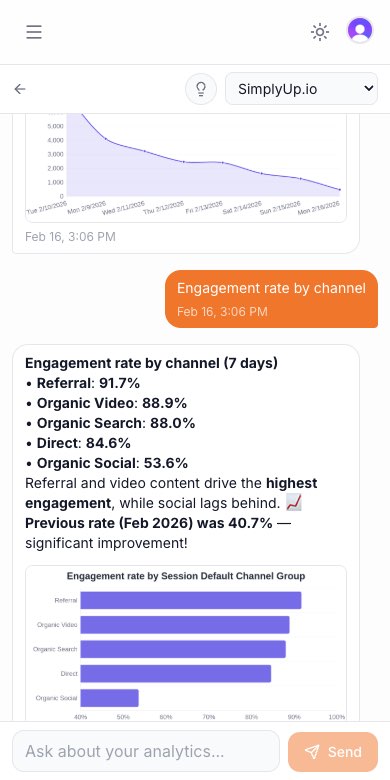
ClawAnalytics mobile chat showing engagement rate breakdown with charts

How ClawAnalytics helps

Skip the dashboards. Get answers in seconds.

🔗
1

Connect GA4

One-click OAuth. Read-only access. Takes 30 seconds to link your Google Analytics property.

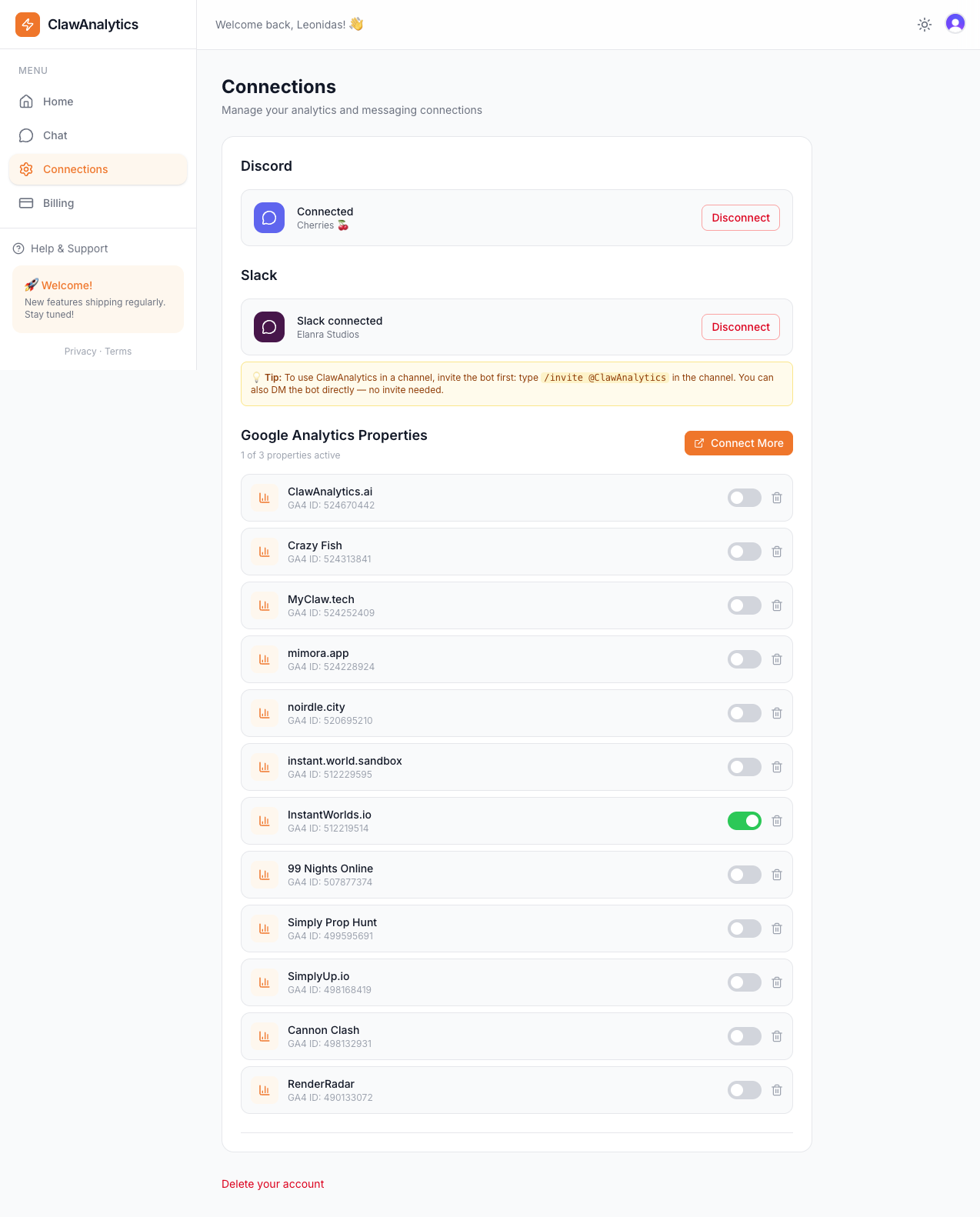
ClawAnalytics connections page showing Google Analytics properties linked
💬
2

Ask questions

Type in plain English. No query language, no filters, no date pickers. Just ask what you want to know.

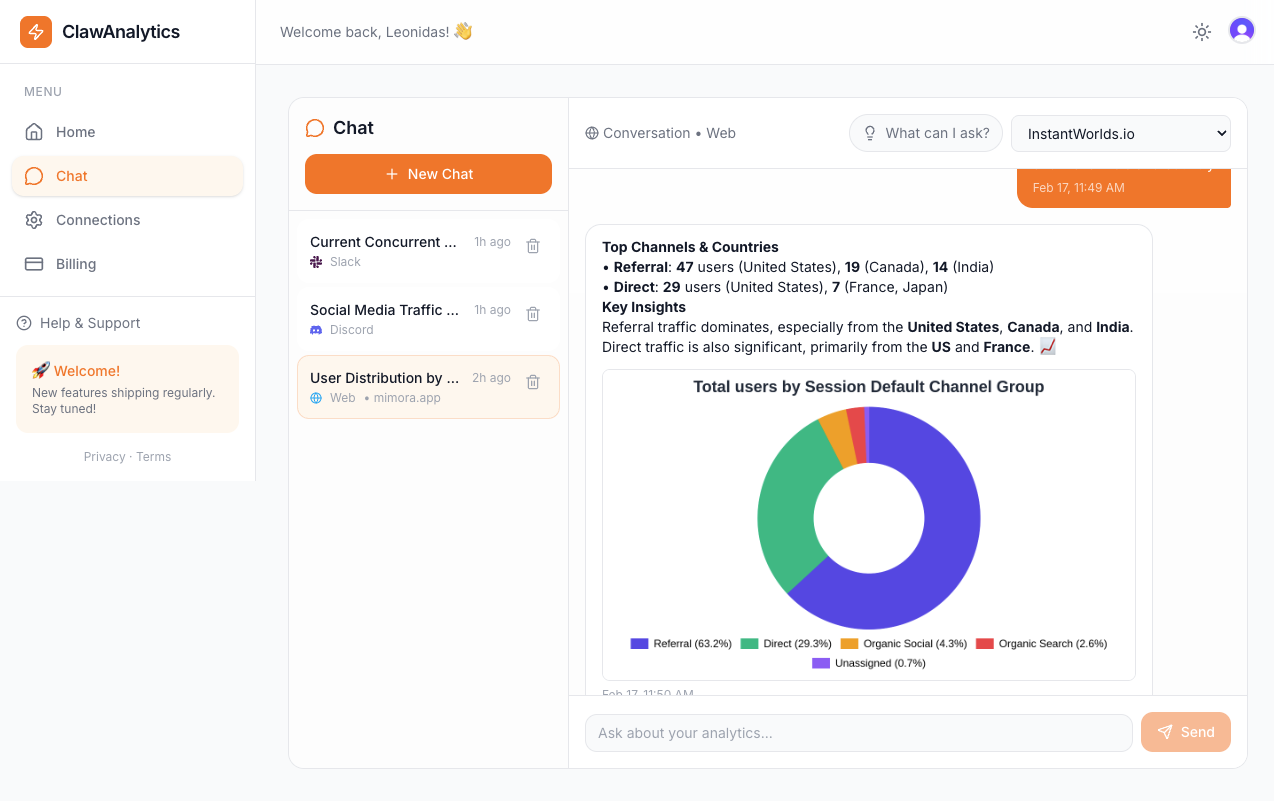
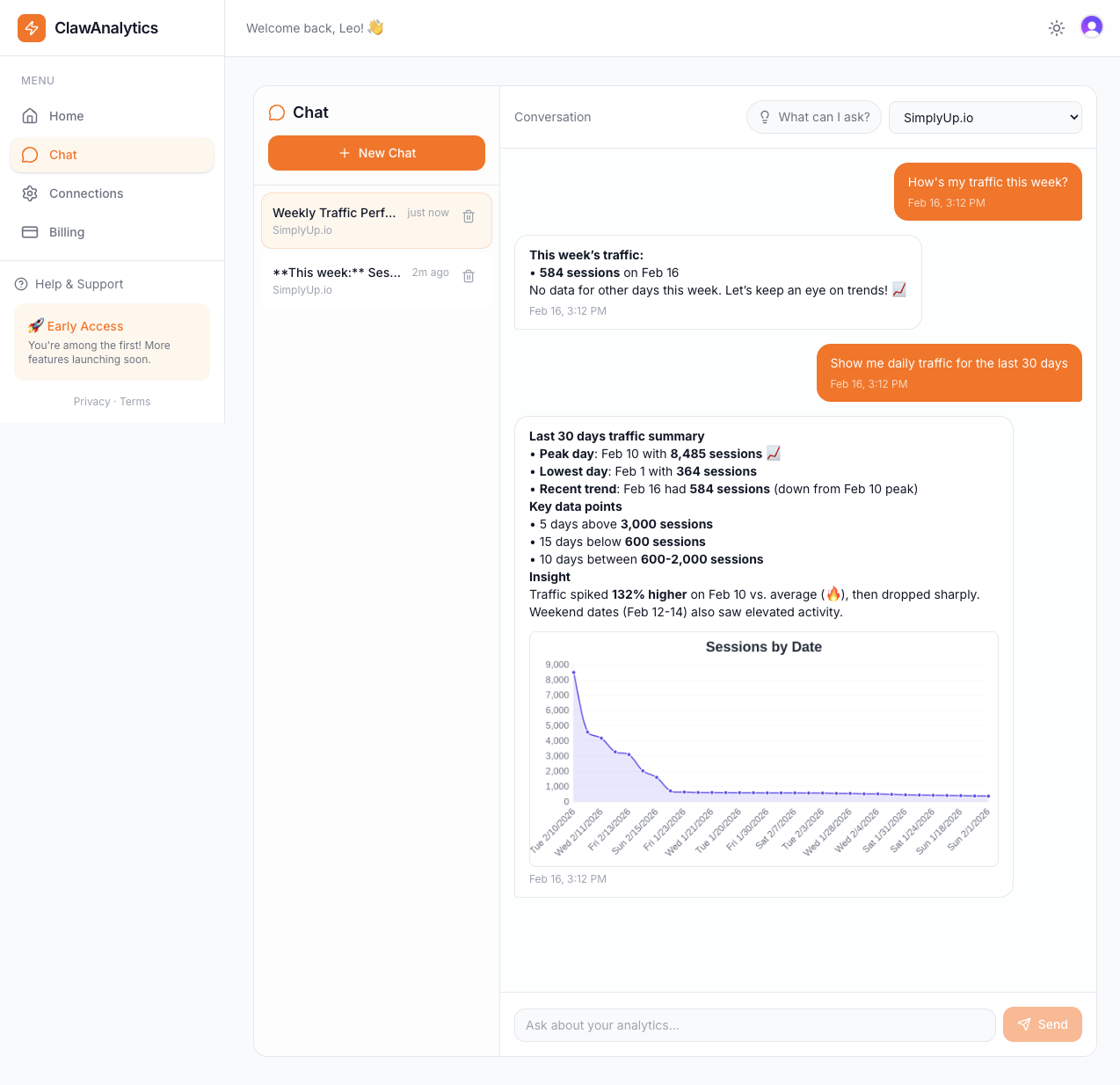
ClawAnalytics chat interface with natural language query
📊
3

Get answers with charts

Instant responses with visualizations. Share charts with your team or export the data.

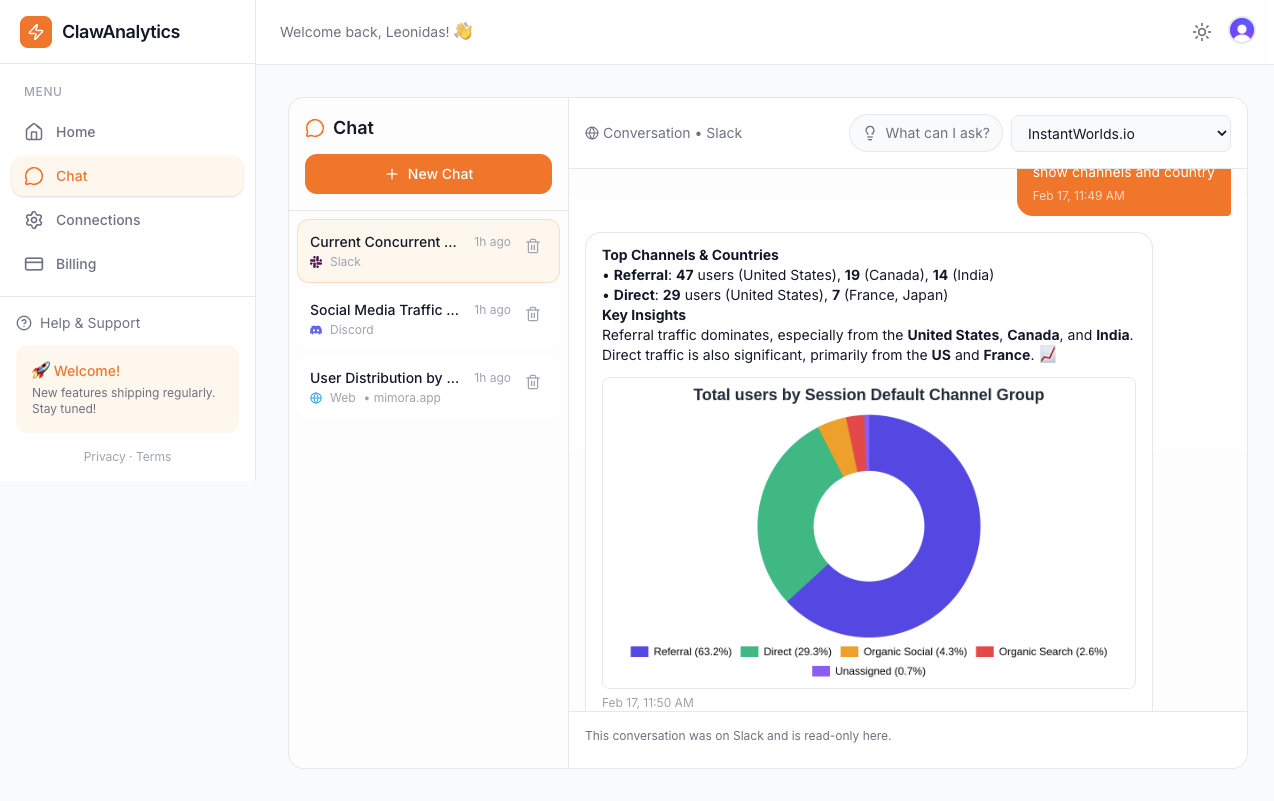
ClawAnalytics showing chart response to analytics query

See it in action

Ask a question. Get a chart. That simple.

ClawAnalytics Chat
ClawAnalytics chat interface showing a natural language analytics query with chart response

Works on web, Discord, and Slack. Also available as an MCP server for AI agents.

Leonidas Maliokas
"I used to open Google Analytics 5 times a day and still miss things. Now I get a summary every morning and ask follow-ups when something looks off. Takes 10 seconds instead of 10 minutes."

Leonidas Maliokas

Founder, Elanra Studios

🎮 5 games monitored 💼 3 businesses

Simple, honest pricing

Start free. Upgrade when you're ready.

Free

Try it out

$0 /month
  • 5 websites
  • 30 questions/month
  • Web dashboard
  • No credit card
Start Free

Website

For small businesses

$9 /month
  • 5 websites connected
  • 100 questions/month
  • Daily morning summary
  • Web dashboard + Discord
Get Started

Business

For agencies and portfolios

$79 /month
  • Unlimited websites
  • 2,000 questions/month
  • Everything in Pro
  • ✅ API access
  • ✅ MCP integration
  • ⭐ Priority support
Get Started

Stop opening dashboards.
Start asking.

Connect Google Analytics in 30 seconds. Get answers from the dashboard or Discord. Start free — no credit card needed.

Try it free — ask your first question
30-second setup Free plan available Cancel anytime

Got questions?

What is a good engagement rate for agency websites?
A healthy engagement rate for agency websites ranges from 55% to 75%. Higher engagement indicates visitors are exploring multiple pages, viewing case studies, and interacting with content. Agencies with strong portfolios typically see 65%+ engagement.
How does engagement rate affect agency lead generation?
Engaged visitors are 4x more likely to submit a contact form or request a quote. When visitors explore more than 3 pages, conversion rates jump from 2% to 8%. Every engaged visitor represents a qualified lead opportunity.
Which agency pages drive the most engagement?
Case study pages and portfolio pieces generate the highest engagement when they feature clear results and client testimonials. Homepage engagement matters less than services page engagement for predicting lead quality.
How can agencies improve low engagement rates?
Add clear navigation to related case studies on every page. Include interactive elements like project calculators or consultation booking widgets. Ensure page load times stay under 3 seconds on mobile devices.

Related guides

More resources to help you get the most from your analytics.