You check your analytics and notice something troubling. Nearly half of your visitors leave after viewing a single product page. They never add anything to their cart. They never checkout. They simply vanish. This is your exit rate, and it tells you exactly where your sales funnel is leaking.
Why Exit Rate Matters for Ecommerce
Exit rate measures the percentage of visitors who leave your site from a specific page. For ecommerce, this metric is crucial because it pinpoints exactly where customers decide not to buy.
A high exit rate on product pages usually signals one of three problems. First, pricing might be higher than what visitors expect. Second, product information might be insufficient for a purchase decision. Third, trust signals might be missing, making visitors hesitant to buy from an unknown store.
Understanding exit rate helps you prioritize improvements. Instead of guessing which pages need work, you get data-driven guidance. If your checkout page has a high exit rate, you know friction exists there. If product pages leak visitors, you know presentation needs work.
Exit rate also reveals seasonal patterns. When you compare exit rates across time periods, you might find certain products perform worse in specific seasons, helping you adjust inventory and marketing accordingly.
Finally, it helps you understand the customer journey. By mapping exit rates across your site, you can see whether visitors are moving toward purchase or bouncing early.
How to Check in GA4
Google Analytics 4 makes checking exit rates straightforward. Start by going to Reports, then select Engagement and Pages.
The pages report shows you each URL along with metrics including exit rate. Exit rate here represents the percentage of sessions that ended on that specific page. Sort by exit rate to find your worst-performing pages quickly.
For deeper analysis, create a conversion path in Explorations. Use entry page and exit page as dimensions with sessions as your metric. This shows you the most common paths visitors take through your site.
You can also set up segment comparisons. Create a segment of visitors who purchased and compare their behavior to those who did not. This reveals differences in how buyers navigate your site versus browsers.
To track cart abandonment specifically, mark your add-to-cart event and checkout start event as conversions. Then compare the number of sessions with these events to sessions that reach checkout completion.
The Easier Way
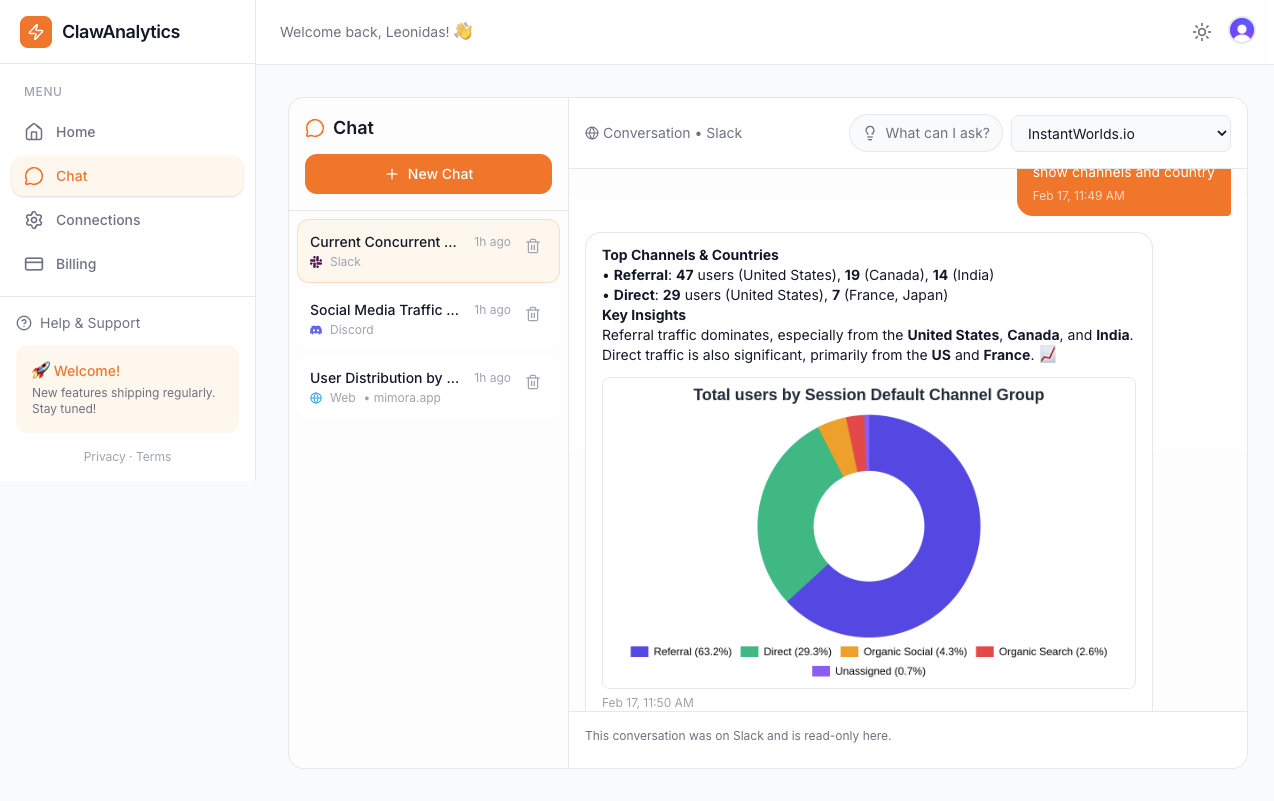
ClawAnalytics gives you immediate insights into your exit rates without the complexity of building custom reports. It automatically flags pages with unusually high exit rates and suggests which issues are most likely causing the problem.
You can ask questions like: Which product category has the highest exit rate? Do customers who view reviews exit less often than those who do not? Does showing shipping costs early reduce exit rate? These answers help you make targeted improvements.
ClawAnalytics also tracks cart abandonment in real-time. When you see exit rates spike after adding items to cart, you know your checkout process needs attention. When product pages leak visitors, you know to improve product presentation or pricing clarity.
Quick Wins
Reduce your ecommerce exit rate with these proven tactics. First, display pricing and shipping costs early. Hidden costs are the number one reason shoppers abandon carts. Second, add customer reviews to every product page. Social proof builds trust and reduces hesitation. Third, optimize product images with multiple angles and zoom functionality. Shoppers want to see exactly what they are buying. Fourth, simplify navigation. If visitors cannot find what they want quickly, they leave. Make your site intuitive and fast.