You just added a cookie consent banner to your website because GA4 requires it. Now 30% of your visitors decline cookies and disappear from your analytics entirely. You are making decisions based on data that misses nearly a third of your actual traffic. This is why privacy-focused alternatives like Plausible are gaining traction.
The Privacy Problem with Google Analytics
GA4 collects user data, sets cookies, and sends information to Google servers. Under GDPR and similar privacy laws, this means you need explicit user consent before tracking. That consent banner you added is not just annoying to visitors. It actively reduces your data accuracy.
Studies show that 20% to 40% of visitors decline cookie consent depending on your audience and region. European visitors decline at higher rates. Tech-savvy audiences decline even more. Every declined visitor becomes invisible to GA4.
Plausible takes a fundamentally different approach. It collects no personal data, sets no cookies, and keeps all data in the EU. No consent banner needed. Every visitor counts.
What You Gain with Plausible
Complete visitor counts. Without consent barriers, Plausible sees every visitor. For some sites, this means 20% to 40% more data than GA4 reports.
Simplicity. Plausible gives you one clean dashboard with traffic, sources, top pages, locations, and devices. No configuration needed. No learning curve. You install a single script tag and you are done.
Speed. The Plausible script is under 1 KB. GA4 loads 45 KB or more. This difference affects your page load speed, which impacts both user experience and search rankings.
GDPR compliance by default. No data processing agreements, no cookie banners, no legal gray areas. Plausible is compliant out of the box.
Open source. Plausible is fully open source. You can self-host it, audit the code, and know exactly what it does with your data.
What You Lose Without GA4
Advanced segmentation. GA4 lets you build complex user segments and compare audience behaviors. Plausible shows aggregate data without the ability to drill into specific user groups.
Google ecosystem integration. GA4 connects natively to Google Ads, Search Console, BigQuery, and Looker Studio. If you run Google Ads, losing this integration hurts your ability to optimize campaigns.
Event-based analytics depth. GA4 handles complex event tracking with parameters, custom dimensions, and calculated metrics. Plausible tracks custom events but with much less flexibility.
Free tier. GA4 is free. Plausible starts at $9 per month and scales with traffic. For high-traffic sites, the cost adds up.
Conversion funnels. GA4 supports multi-step funnel analysis. Plausible added basic goal tracking but does not match GA4 funnel capabilities.
Making It Work Together
You do not have to choose one or the other. Many sites run Plausible for accurate traffic counts and daily monitoring while keeping GA4 for campaign tracking and deeper analysis. Plausible becomes your quick daily dashboard. GA4 becomes your deep-dive tool.
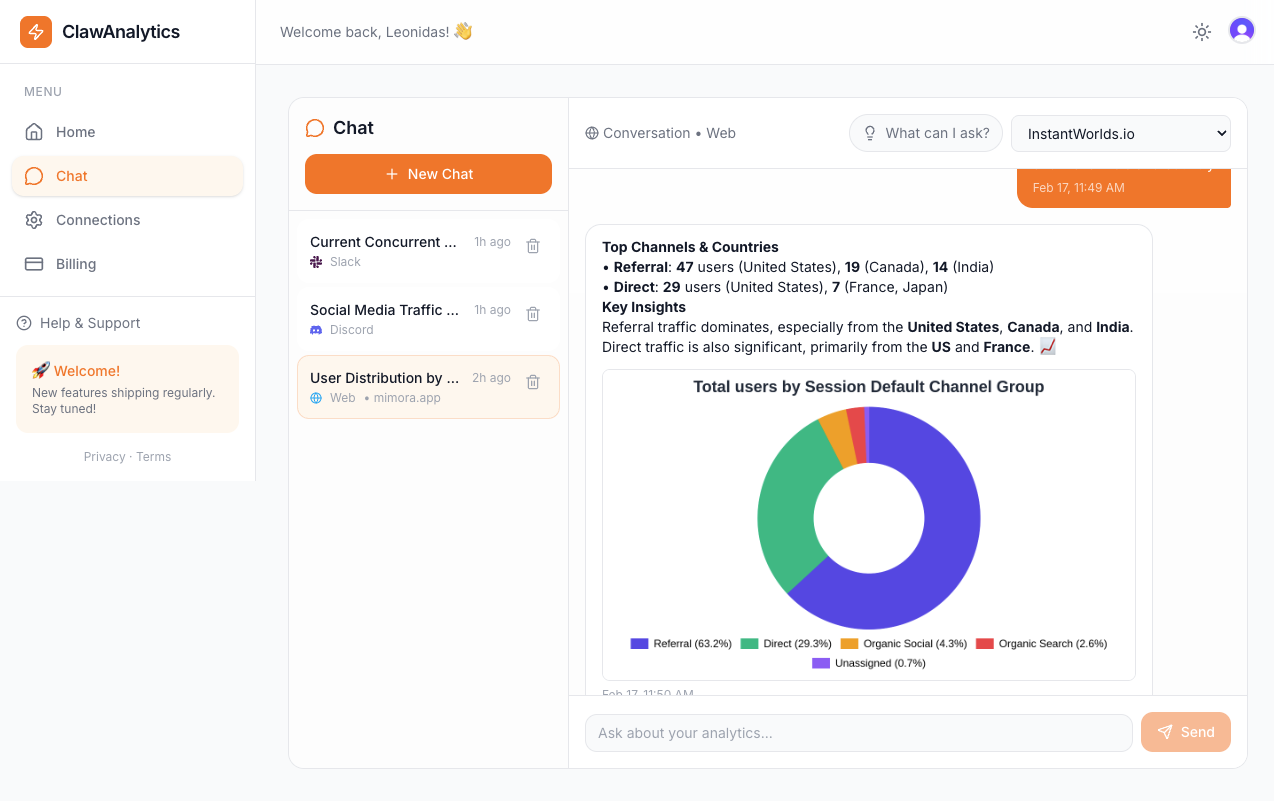
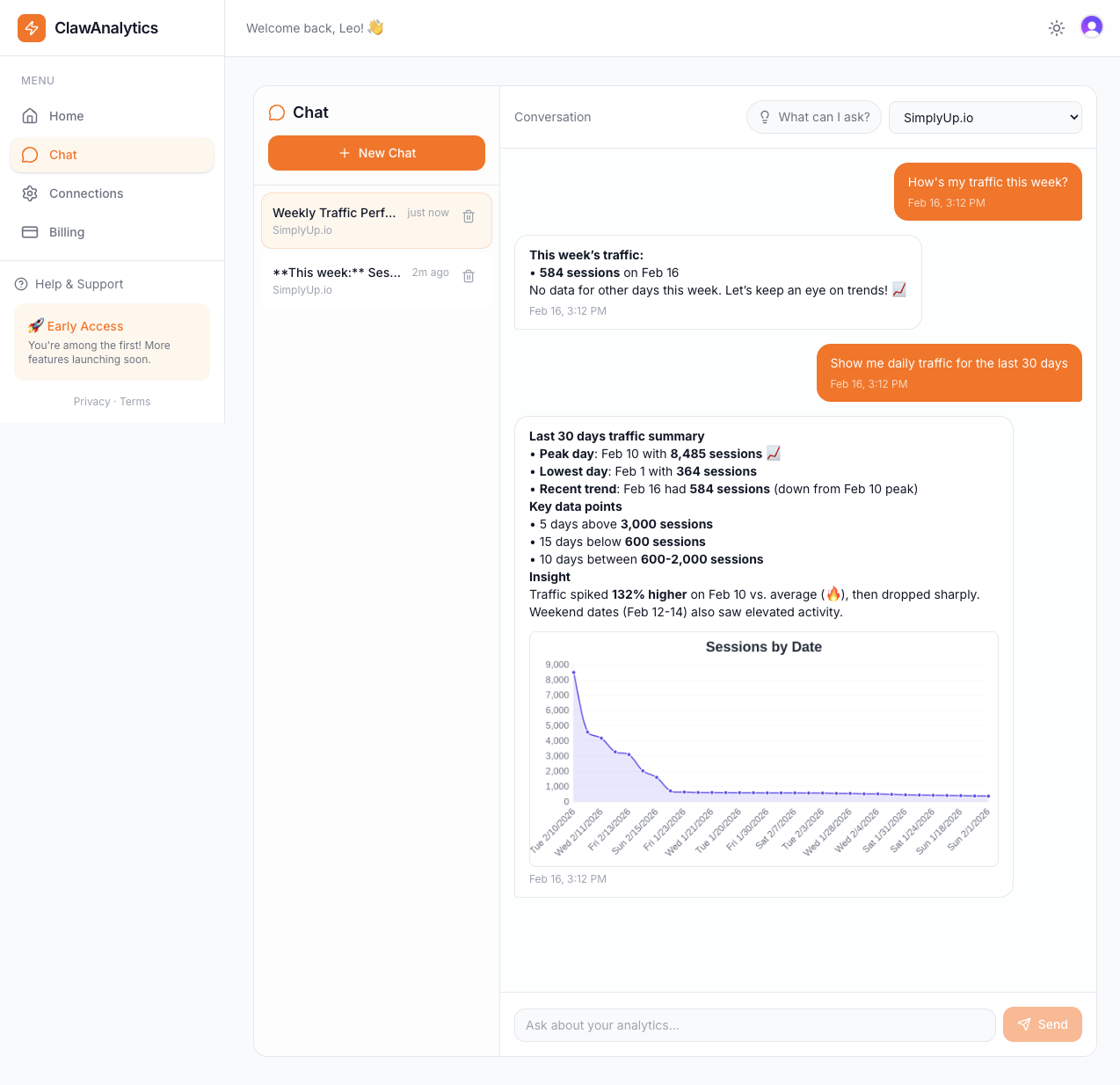
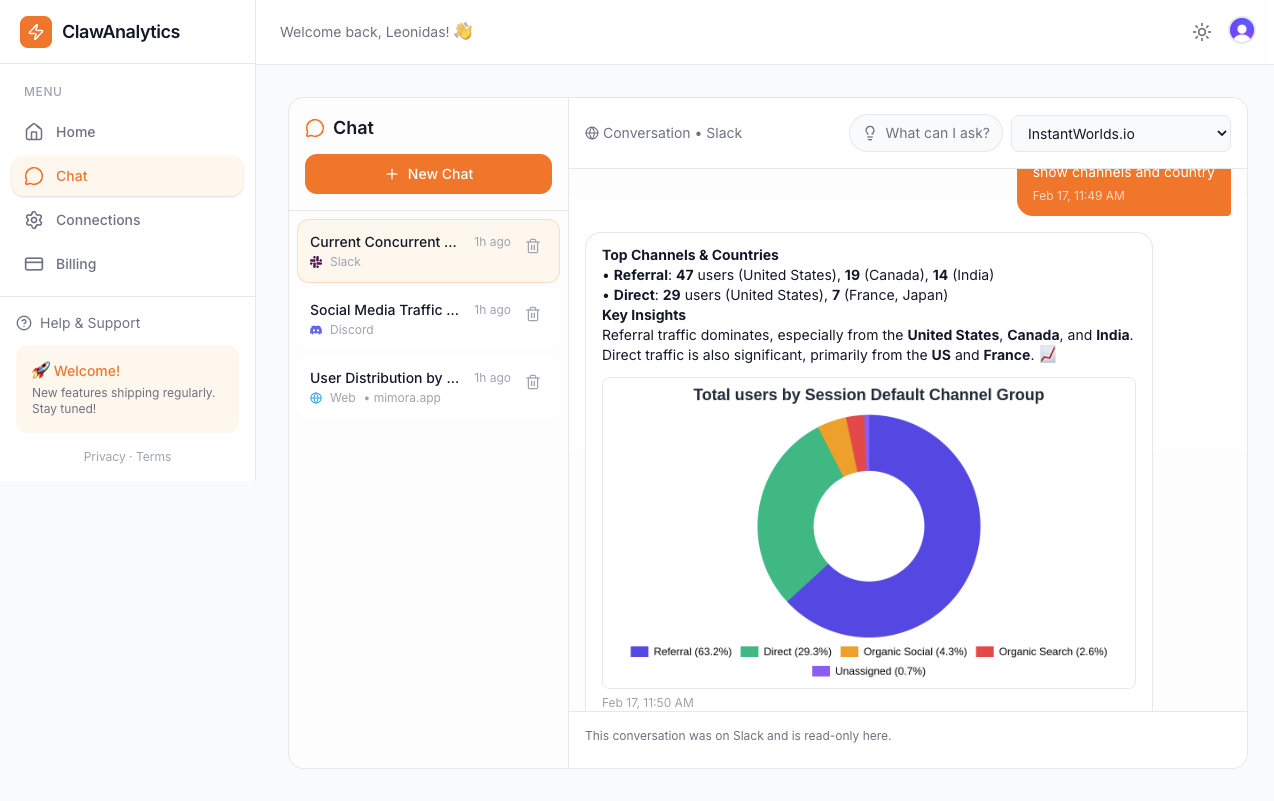
If you use GA4 and want clearer answers without the complexity, ClawAnalytics lets you ask questions about your data conversationally. You get the depth of GA4 data with a much simpler interface, and you do not need to learn Explorations or build custom reports.
Quick Wins
-
Test Plausible with a 30-day trial. Run it alongside GA4 and compare traffic numbers. The gap between what each tool reports will show you how many visitors your consent banner is hiding.
-
Check your consent decline rate. Look at how many visitors decline your cookie banner. If it is over 25%, you are making decisions on incomplete data and should consider a cookieless option.
-
Use Plausible for content sites. If your site is primarily content, blog posts, or documentation, Plausible gives you everything you need at a fraction of the complexity.
-
Keep GA4 for paid campaigns. If you spend money on Google Ads, GA4 integration is too valuable to drop. Use both tools and let each do what it does best.