How to Track Return On Ad Spend for Dentists
Your dental practice dropped $4,000 on Google Ads last month for implant advertising. You got 60 form submissions and 25 actually booked consultations. Of those, 8 became implant patients at $3,500 each. That’s $28,000 in implant revenue from $4,000 in ad spend, which is a 7x ROAS. But what about your other campaigns? Are you losing money on whitening ads while winning on implants? You need ROAS tracking to know for sure.
Why Return On Ad Spend Matters for Dentists
Treatment values vary enormously. A routine cleaning brings in $150, while a full implant restoration brings $8,000+. ROAS helps you see which treatments actually profit from advertising.
New patient acquisition is the lifeblood. Most dental practices need a constant flow of new patients to grow. ROAS tells you exactly how much you’re spending to get each new face through the door.
Insurance complicates things. Different insurance plans cover different treatments. ROAS helps you understand which patients, regardless of insurance, actually generate profit.
Referrals vs. ads have different costs. Your existing patients send friends, but that costs nothing in ad spend. ROAS reveals when paid advertising makes sense versus when to invest in referral programs.
How to Check in GA4
Mark appointment bookings as conversions. In Configure > Events, find your booking confirmation events and enable them as conversions. This is essential for any ROAS measurement.
Create treatment-type dimensions. Tag your campaigns so you can see ROAS for cleanings versus whitening versus implants separately. This reveals which treatments justify higher ad costs.
Link your Google Ads account. Go to Configure > Google Ads links to connect your advertising data. This lets GA4 see both what you spent and what you earned.
Set up patient value tracking. If your practice management system exports patient data, connect it to see lifetime value per acquisition source.
The Easier Way
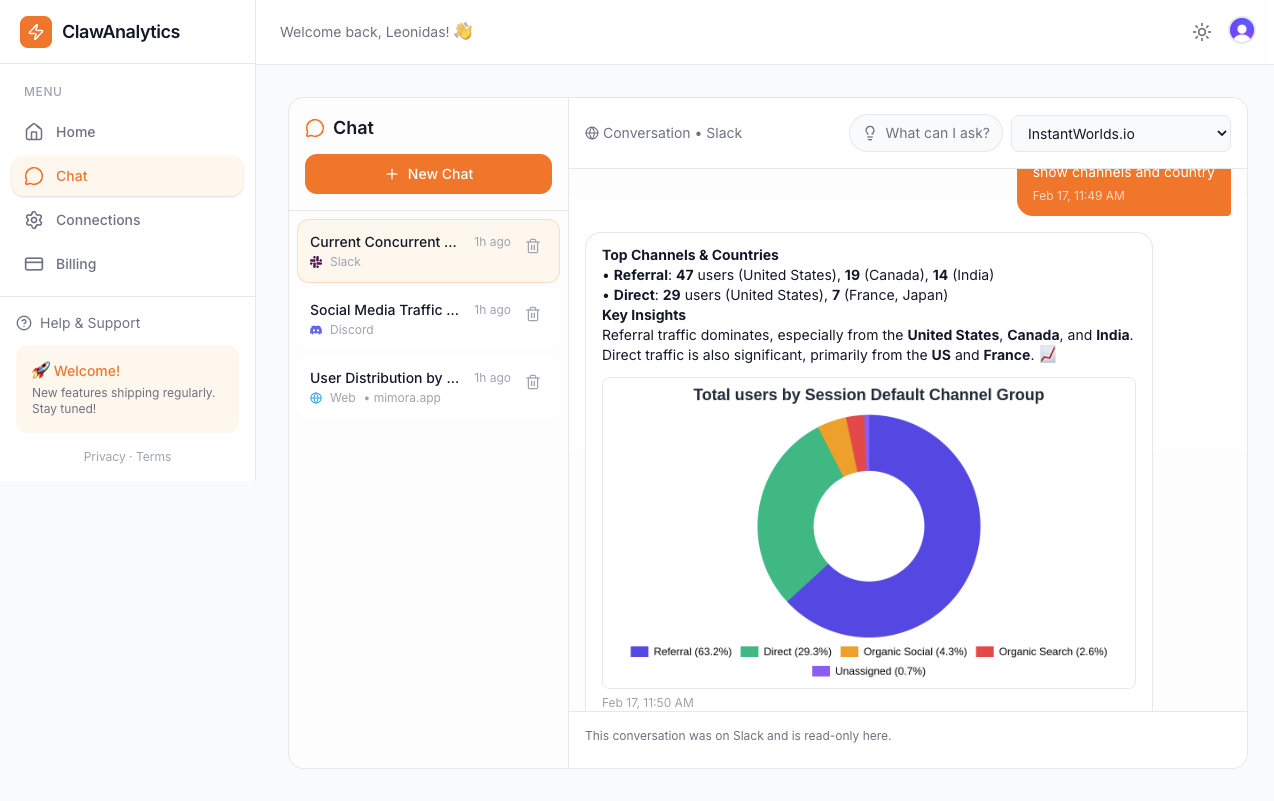
ClawAnalytics was built for this. Ask: “Which Google Ads campaigns are generating the most implant patients?” and see exactly which keywords and ads work best.
Another powerful question: “Are our Facebook ads for teeth whitening more profitable than our Google search ads?” Compare platforms to allocate budget where it performs best.
You can also ask: “What’s the cost to acquire a new patient for invisalign versus traditional braces?” This helps you understand which treatments drive growth.
The real advantage is getting answers in seconds instead of building custom reports in GA4.
Quick Wins
Track cost per new patient, not just cost per call. Calls are vanity metrics. The question is how many become actual patients.
Separate insurance from cash patients. A cash patient for cosmetic work is worth more than an insurance-only patient. Segment your ROAS accordingly.
Promote high-value treatments in ads. Implants, veneers, and orthodontics have higher values and can justify more aggressive advertising than routine care.
Review monthly during slow periods. Dental marketing has seasonal patterns. Monthly ROAS reviews help you spot trends early and adjust before they hurt your bottom line.