How to Track Return On Ad Spend for Food Delivery
You launched Instagram ads for your ghost kitchen. A week later, you’ve gotten 200 clicks and 45 orders. Sounds great, right? But if those orders total $900 in revenue and you spent $600 on ads, your ROAS is only 1.5. After platform fees and delivery costs, you might be breaking even or losing money.
Return on ad spend tells you the real story.
Why Return On Ad Spend Matters for Food Delivery
Platform fees are huge. Delivery apps charge 15-30% per order. Marketing on top of that means you need healthy ROAS just to profit.
Customer acquisition costs add up. Getting a new customer to try your delivery service costs more than retaining an existing one. ROAS shows whether your acquisition spending pays off.
Menu items have different margins. That $12 burger might cost $4 in food costs, while the $15 salad costs $6. ROAS helps you understand which items drive profitable orders.
Competition is constant. New delivery options appear every week. ROAS tracking shows whether your brand awareness campaigns are holding ground or losing share.
How to Check in GA4
First, set up conversion tracking for orders. Use e-commerce tracking in GA4 to capture transaction values. This gives you the revenue side of the ROAS equation.
Track both app orders and website orders if you have a direct ordering option. Import average order values so you can calculate ROAS even when tracking individual transactions is tricky.
Create a custom report in Google Ads showing Conversion Value by Campaign. Compare this against your ad spend. A ROAS above 3.0 usually covers fees and leaves profit, but your target depends on margins.
Check performance daily during launch periods. Food delivery demand shifts fast based on trends, weather, and local events.
The Easier Way
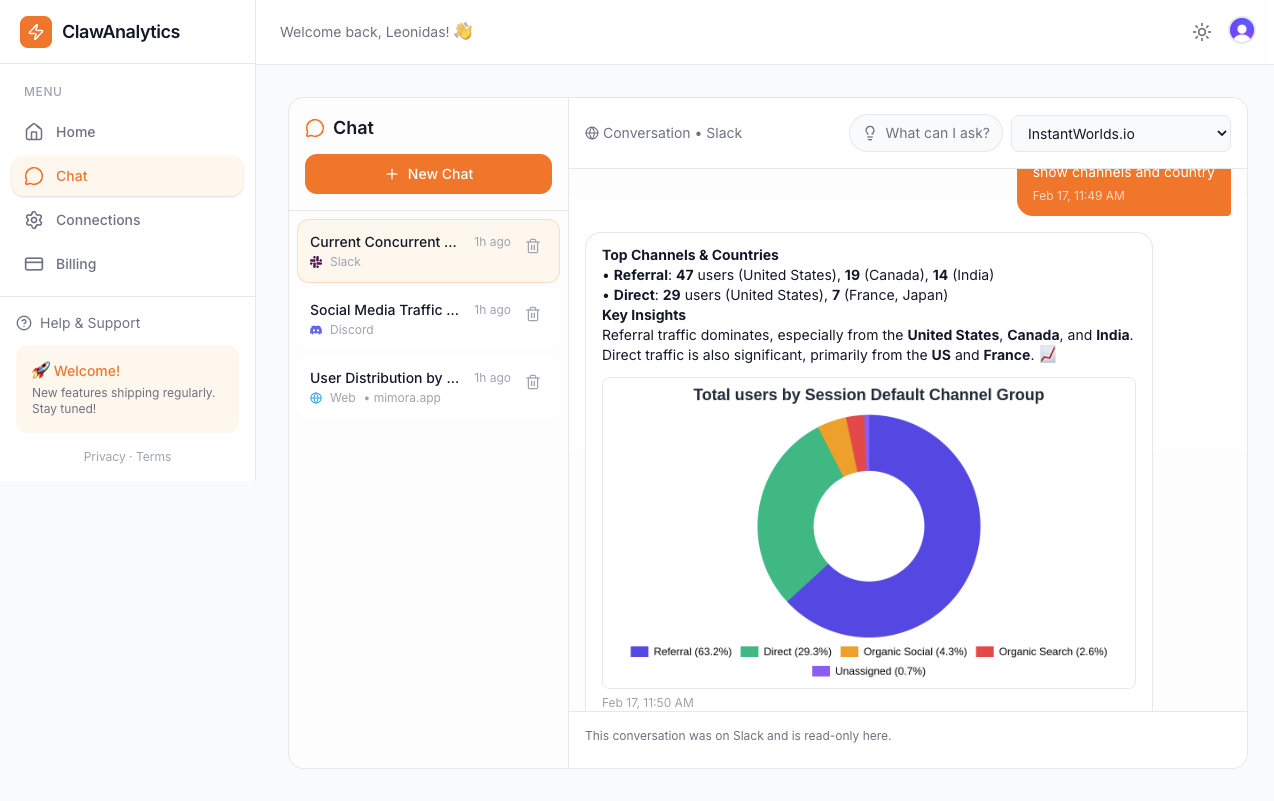
ClawAnalytics simplifies delivery ad tracking.
The challenge with food delivery is that platform fees vary by order. ClawAnalytics lets you input your average fee percentage so it calculates true ROAS, not just apparent revenue.
You see which campaigns drive the most profitable orders:
- Are your Instagram promos attracting budget-conscious customers who use coupons?
- Does your geo-targeting reach high-income neighborhoods with bigger ticket sizes?
- Which cuisine promotions generate repeat customers?
The platform also benchmarks your ROAS against similar delivery businesses so you know if you’re competitive.
Quick Wins
Target your delivery radius precisely. Most delivery services cover 2-5 miles. Use geo-fencing to avoid showing ads to people outside your delivery zone.
Promote bundle deals. Higher order values improve ROAS. “Get a free drink with any entree” nudges customers toward bigger baskets.
Run retargeting ads for cart abandoners. Many customers browse but don’t order. Retargeting usually has better ROAS because these users already know your brand.
Time your promotions around peak hours. Dinner rush (5-8pm) typically has higher conversion rates. Schedule your biggest ad spend for when people are deciding where to order.