Local Business Last updated February 23, 2026

How to Track Traffic Sources for Local Business

Your local business traffic sources reveal key insights. Learn what causes issues, what good looks like, and how to fix it with real data.

Your neighbor runs a plumbing company in town. Last month, someone searched “emergency plumber near me” on their phone, found his website, and called within 10 minutes. That customer became a $400 repeat client. This is exactly the kind of connection local businesses need to track.

Why Traffic Sources Matter for Local Business

Understanding where your website visitors come from helps you spend marketing dollars wisely. If you spend $500 on Google Ads but 80% of your leads come from organic search, you need to shift strategy.

For local businesses, each traffic source represents real revenue. A visitor from Google Maps is often ready to buy. Someone who found you through a local blog post might take longer to convert but could become a loyal customer. Knowing these patterns helps you focus on what works.

Consider this: if your website gets 500 visitors monthly and 40% come from paid search at $2 per click, that’s $400 in ad spend. But if 25% come from organic search (free) and convert at a higher rate, investing in SEO might deliver better returns.

What Causes Local Business Traffic Issues

Inconsistent business information across directories creates confusion. If your address shows differently on Yelp, Google, and your website, search engines struggle to verify your location, hurting local rankings.

Missing Google Business Profile optimization means you’re invisible to nearby customers. Many local businesses claim their profile but never add photos, hours, or posts.

Landing pages that dont match search intent frustrate visitors. Someone searching for “emergency plumber” wants immediate contact options, not a lengthy about page.

No mobile optimization hurts badly since 60%+ of local searches happen on phones. If your site loads slowly or looks broken on mobile, visitors leave immediately.

Ignoring review sites damages reputation. Most customers check reviews before contacting a local business, and businesses with few or negative reviews get passed over.

How to Track It

Start with Google Analytics 4. Set up your property, then navigate to Acquisition reports to see Traffic Acquisition. This shows you exactly where visitors originate: organic search, paid search, direct, referral, or social.

For local businesses, you need to connect Google Analytics with Google Business Insights. This shows how many people found you through Maps searches, requested directions, or clicked your phone number.

ClawAnalytics adds deeper context. Ask questions like “Which neighborhoods generate the most converting traffic?” or “Are emergency service searches bringing in different customers than routine service searches?” The AI analyzes patterns you might miss, helping you understand not just where traffic comes from, but which sources deliver customers who actually pay.

Track specific campaigns using UTM parameters. Create unique links for each marketing channel so you can measure exactly which flyer, ad, or email drove each visitor.

Quick Wins

  1. Claim and optimize every directory listing - Start with Google Business Profile, then Yelp, Apple Maps, and industry-specific directories. Keep name, address, and phone number identical everywhere.

  2. Add location pages if you serve multiple areas - Create separate pages for each city or neighborhood you serve, with unique content and local references.

  3. Install call tracking - Use services like CallRail or RingCentral to assign unique numbers to different marketing channels, then connect this data to your analytics.

  4. Monitor Google Search Console - See which local queries bring users to your site, identify indexing issues, and track your local search positions over time.
Check your analytics from anywhere

On your morning commute. At a coffee shop. In a meeting. Pull up your analytics on any device and get instant answers.

  • Web dashboard on desktop & mobile
  • Discord bot for team channels
  • Slack integration for your workspace
  • MCP server for AI agents (Claude, Cursor)
See your traffic in 60 seconds →
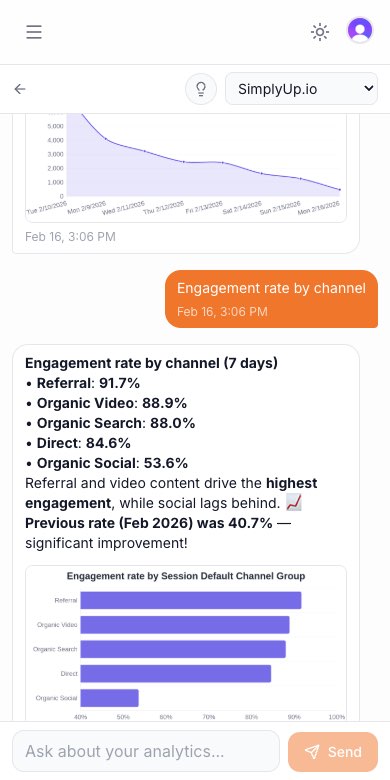
ClawAnalytics mobile chat showing engagement rate breakdown with charts

How ClawAnalytics helps

Skip the dashboards. Get answers in seconds.

🔗
1

Connect GA4

One-click OAuth. Read-only access. Takes 30 seconds to link your Google Analytics property.

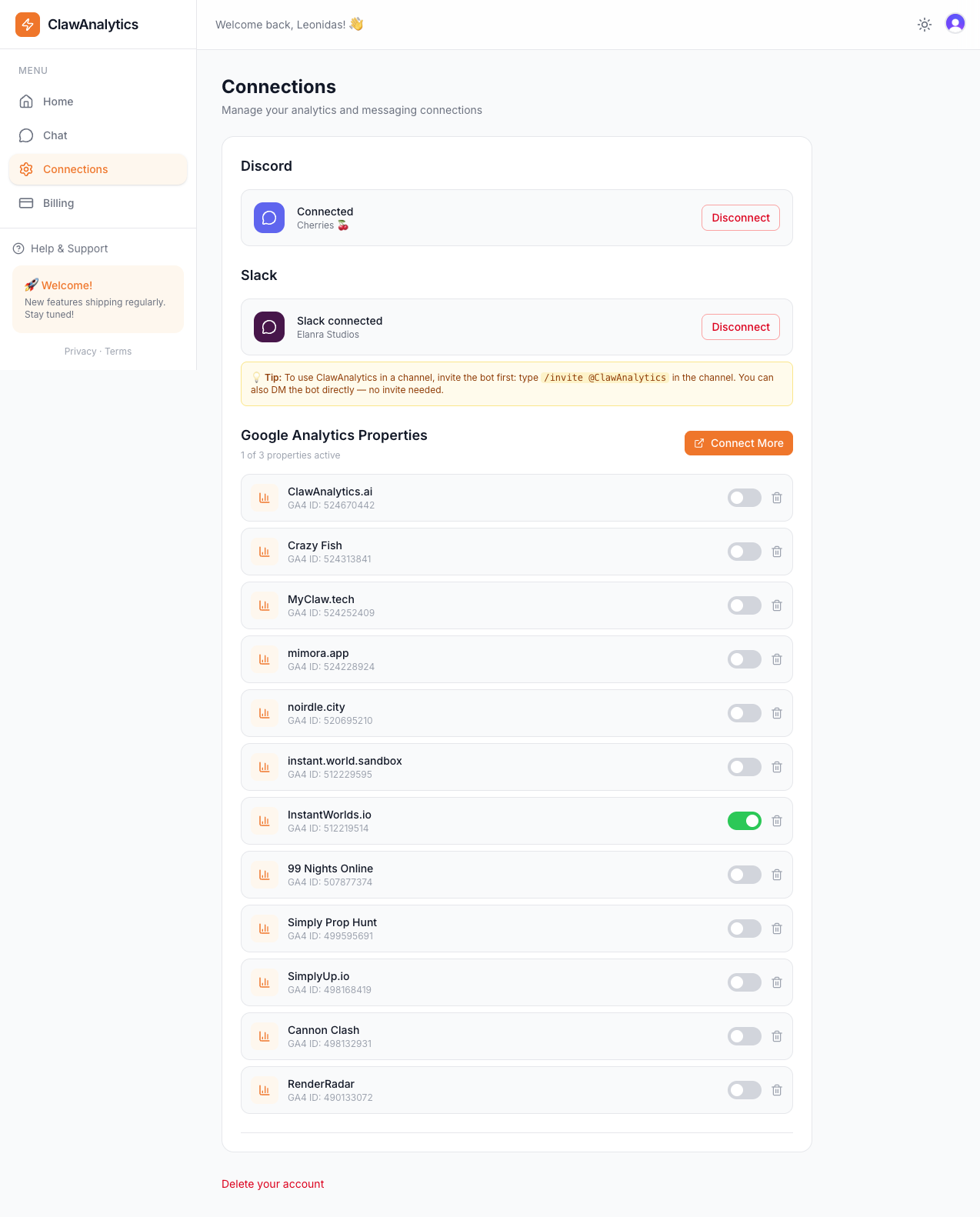
ClawAnalytics connections page showing Google Analytics properties linked
💬
2

Ask questions

Type in plain English. No query language, no filters, no date pickers. Just ask what you want to know.

ClawAnalytics chat interface with natural language query
📊
3

Get answers with charts

Instant responses with visualizations. Share charts with your team or export the data.

ClawAnalytics showing chart response to analytics query

See it in action

Ask a question. Get a chart. That simple.

ClawAnalytics Chat
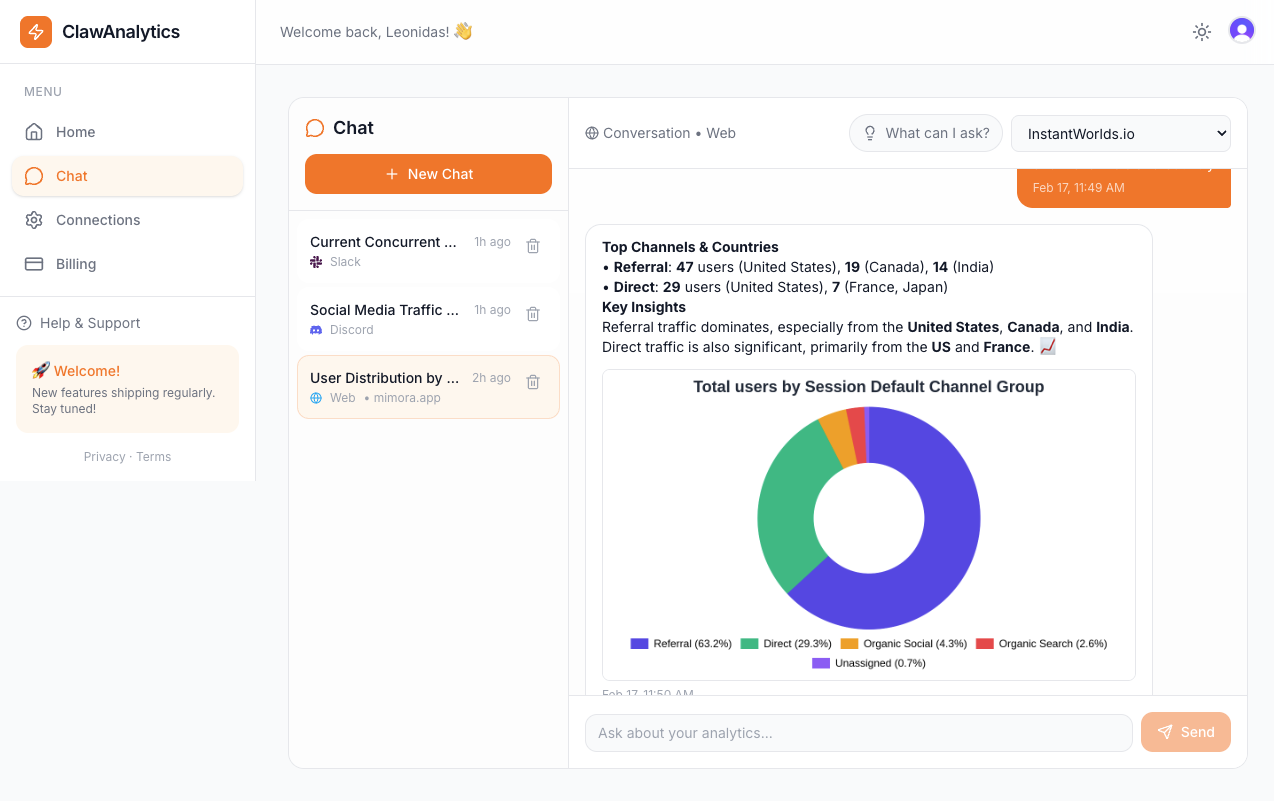
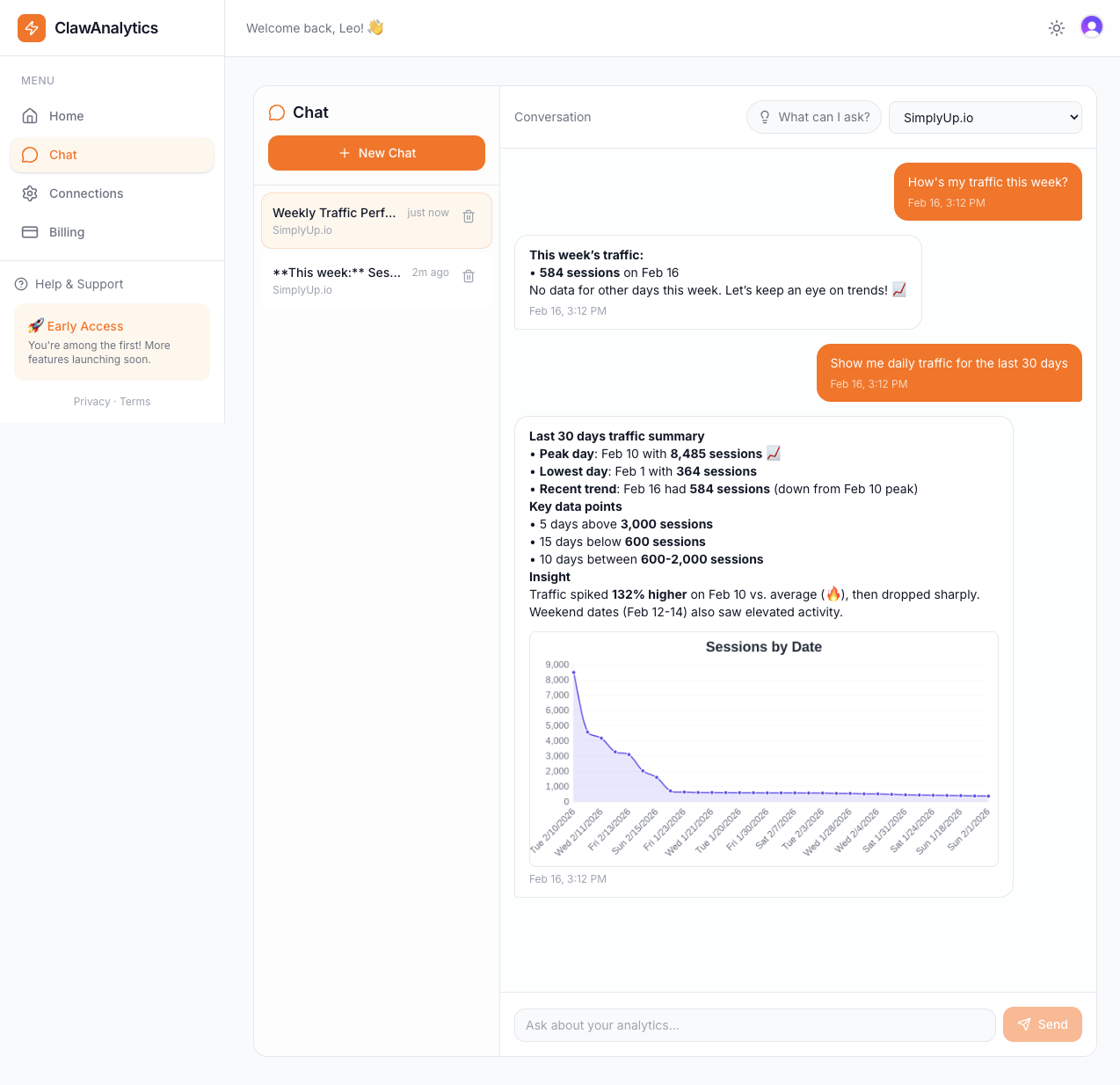
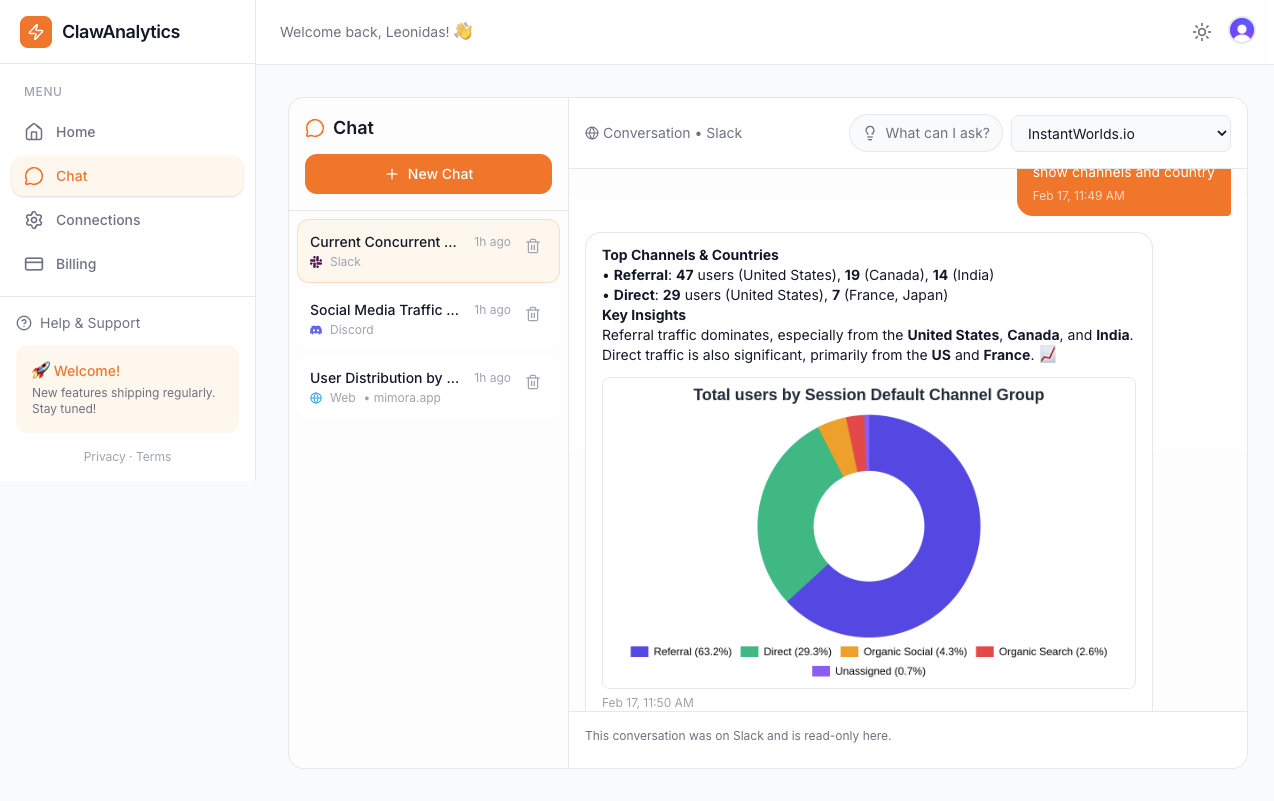
ClawAnalytics chat interface showing a natural language analytics query with chart response

Works on web, Discord, and Slack. Also available as an MCP server for AI agents.

Leonidas Maliokas
"I used to open Google Analytics 5 times a day and still miss things. Now I get a summary every morning and ask follow-ups when something looks off. Takes 10 seconds instead of 10 minutes."

Leonidas Maliokas

Founder, Elanra Studios

🎮 5 games monitored 💼 3 businesses

Simple, honest pricing

Start free. Upgrade when you're ready.

Free

Try it out

$0 /month
  • 5 websites
  • 30 questions/month
  • Web dashboard
  • No credit card
Start Free

Website

For small businesses

$9 /month
  • 5 websites connected
  • 100 questions/month
  • Daily morning summary
  • Web dashboard + Discord
Get Started

Business

For agencies and portfolios

$79 /month
  • Unlimited websites
  • 2,000 questions/month
  • Everything in Pro
  • ✅ API access
  • ✅ MCP integration
  • ⭐ Priority support
Get Started

Stop opening dashboards.
Start asking.

Connect Google Analytics in 30 seconds. Get answers from the dashboard or Discord. Start free — no credit card needed.

Try it free — ask your first question
30-second setup Free plan available Cancel anytime

Got questions?

What is a good bounce rate for local business websites?
A good bounce rate for local business websites is between 25-45%. Service-based businesses often see lower rates (25-35%) since visitors typically need multiple pages, while retail local sites may hover around 40-45%.
How do I get more Google Maps traffic to my local business site?
Optimize your Google Business Profile with current photos, respond to reviews, and post regularly. Add location-specific landing pages on your website and include local keywords in your content.
Should local businesses track call tracking separately?
Yes, implementing call tracking numbers helps you attribute phone calls to specific campaigns. Most local businesses see 60-70% of inquiries come via phone, making this critical for accurate ROI measurement.
Direct traffic seems high for my local business. Is that normal?
Direct traffic for local businesses often includes walk-ins who found you nearby, brand searches, and repeat customers. If direct seems inflated, check that your tracking is properly set up and not missing referral sources.

Related guides

More resources to help you get the most from your analytics.