SaaS Last updated February 22, 2026

How to Track Bounce Rate for SaaS

Learn how to track and improve bounce rate for your SaaS business using Google Analytics and ClawAnalytics.

Bounce rate is one of the most telling metrics for SaaS businesses because it reveals whether your landing page messaging matches visitor intent. When a user lands on your pricing page and leaves immediately, it signals a disconnect between what they expected and what they found.

Why Bounce Rate Matters for SaaS

SaaS companies live and die by conversion rates. A 70% bounce rate on your homepage means 7 out of 10 visitors leave without exploring your product. For a SaaS business spending $50 per click on ads, that translates to $35 wasted on every 10 visitors.

Bounce rate also exposes product-market fit issues. If your feature page bounces at 65%, visitors are either arriving from the wrong traffic source or your messaging fails to communicate value within seconds. B2B SaaS companies with strong product-market fit typically maintain bounce rates below 40% on their highest-traffic pages.

Tracking bounce rate by traffic source reveals which channels deliver qualified visitors. Ads from branded keywords might show 30% bounce rates while generic industry terms show 60%. This data helps marketing teams allocate budget toward high-intent traffic.

How to Track It

In Google Analytics 4, navigate to Reports then Acquisition. Create a custom exploration with Bounce Rate as a metric and Landing Page as a dimension. Filter by your SaaS pages such as homepage, pricing, and features.

Set up a comparison segment for different traffic sources. Compare organic search visitors against paid social visitors. This reveals whether your SEO content attracts more engaged users than your ad campaigns.

Create a custom alert for bounce rates exceeding 55% on any page. In GA4, go to Configure then Alerts and set the threshold. This proactive notification helps teams address issues before they impact conversion rates.

Export bounce rate data weekly to track trends. A gradual increase of 5% or more over two weeks typically signals a problem worth investigating, such as a broken page element or changed messaging.

How ClawAnalytics Makes This Easy

Instead of building custom GA4 reports, you can ask ClawAnalytics: “Why is our pricing page bouncing at 60% this week?” The AI analyzes your analytics data and returns specific insights, such as “Mobile users are bouncing 20% higher than desktop, likely due to slow load times.”

This approach eliminates the need to navigate complex dashboards. You get answers in plain English rather than spending hours filtering data in GA4. Teams can focus on implementing fixes rather than debugging report configurations.
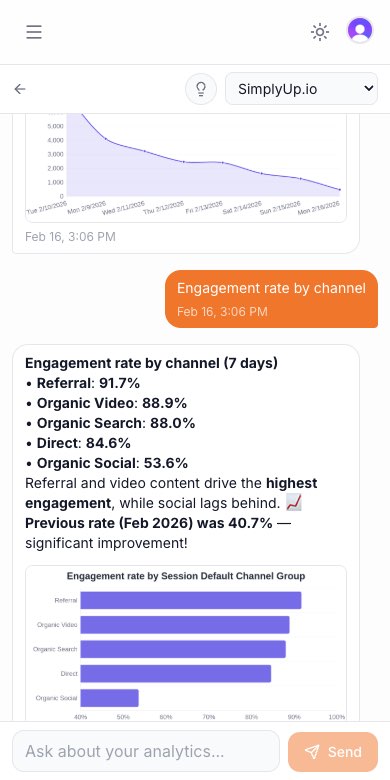
Check your analytics from anywhere

On your morning commute. At a coffee shop. In a meeting. Pull up your analytics on any device and get instant answers.

  • Web dashboard on desktop & mobile
  • Discord bot for team channels
  • Slack integration for your workspace
  • MCP server for AI agents (Claude, Cursor)
See your traffic in 60 seconds →
ClawAnalytics mobile chat showing engagement rate breakdown with charts

How ClawAnalytics helps

Skip the dashboards. Get answers in seconds.

🔗
1

Connect GA4

One-click OAuth. Read-only access. Takes 30 seconds to link your Google Analytics property.

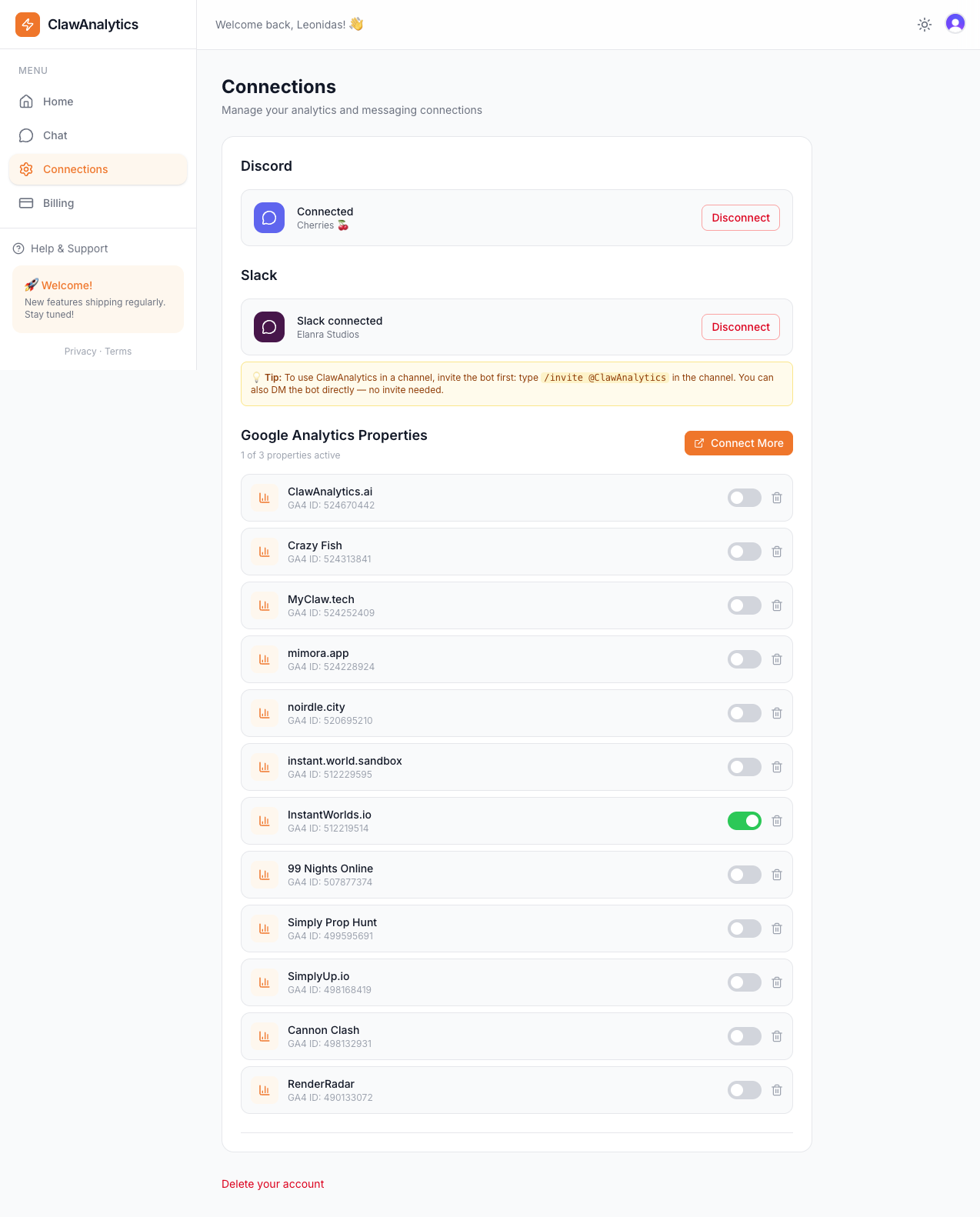
ClawAnalytics connections page showing Google Analytics properties linked
💬
2

Ask questions

Type in plain English. No query language, no filters, no date pickers. Just ask what you want to know.

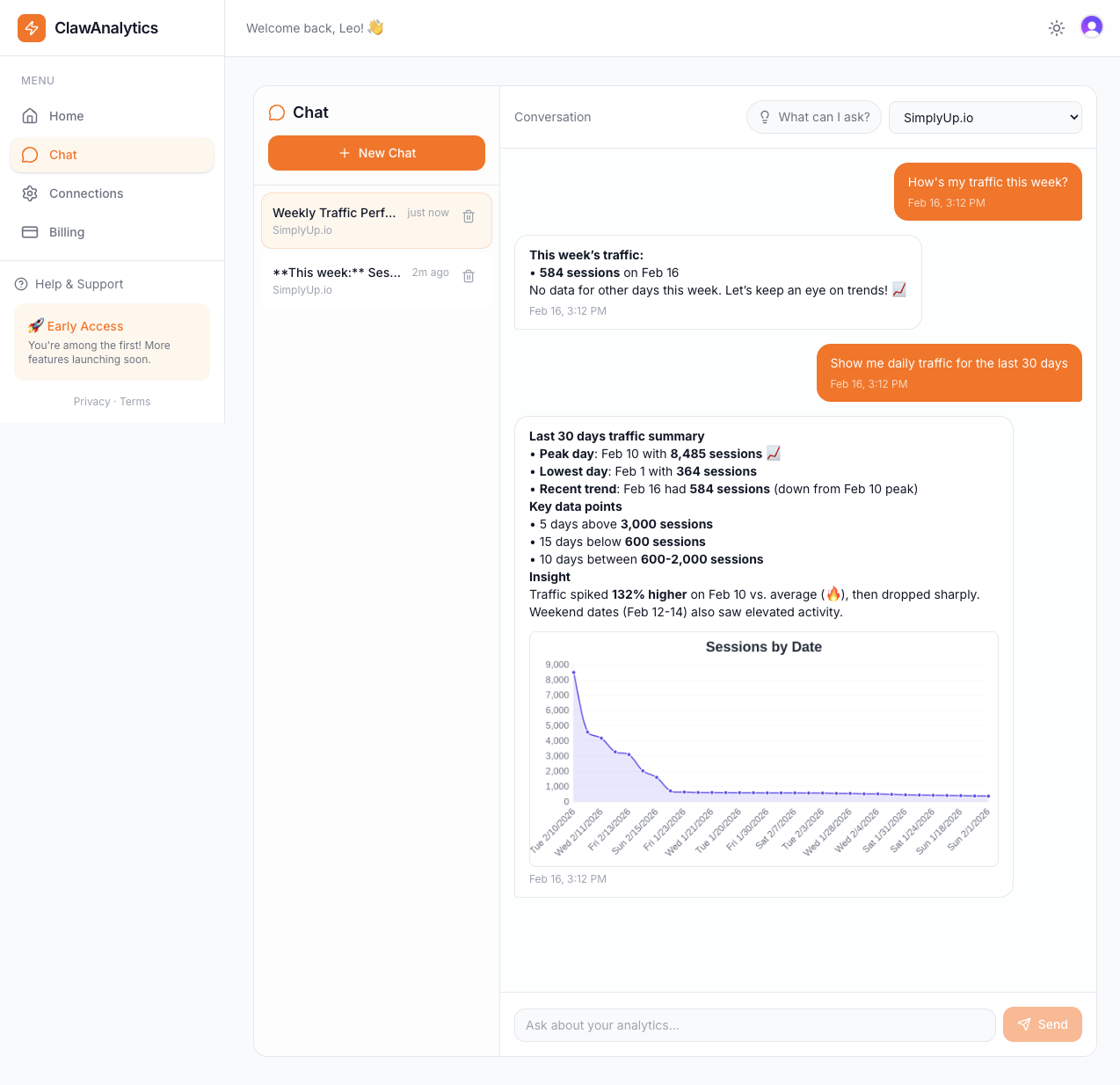
ClawAnalytics chat interface with natural language query
📊
3

Get answers with charts

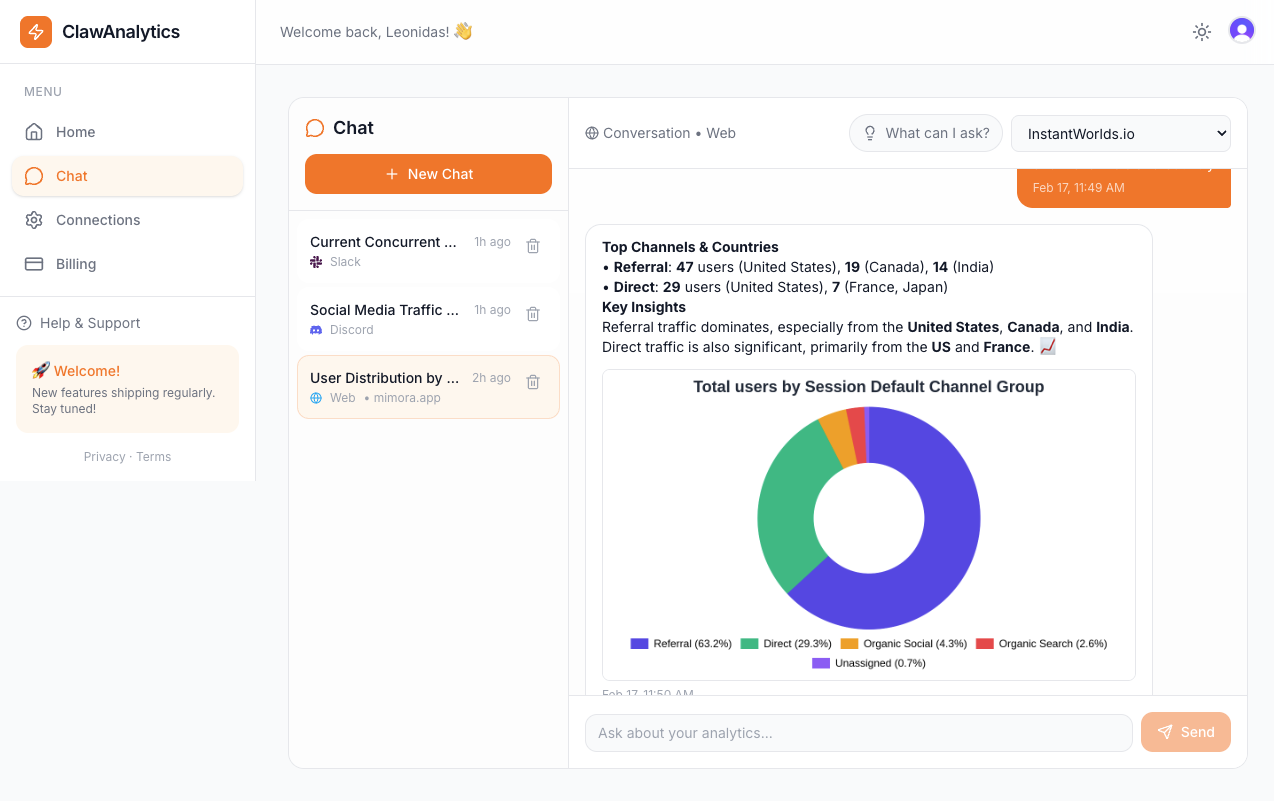
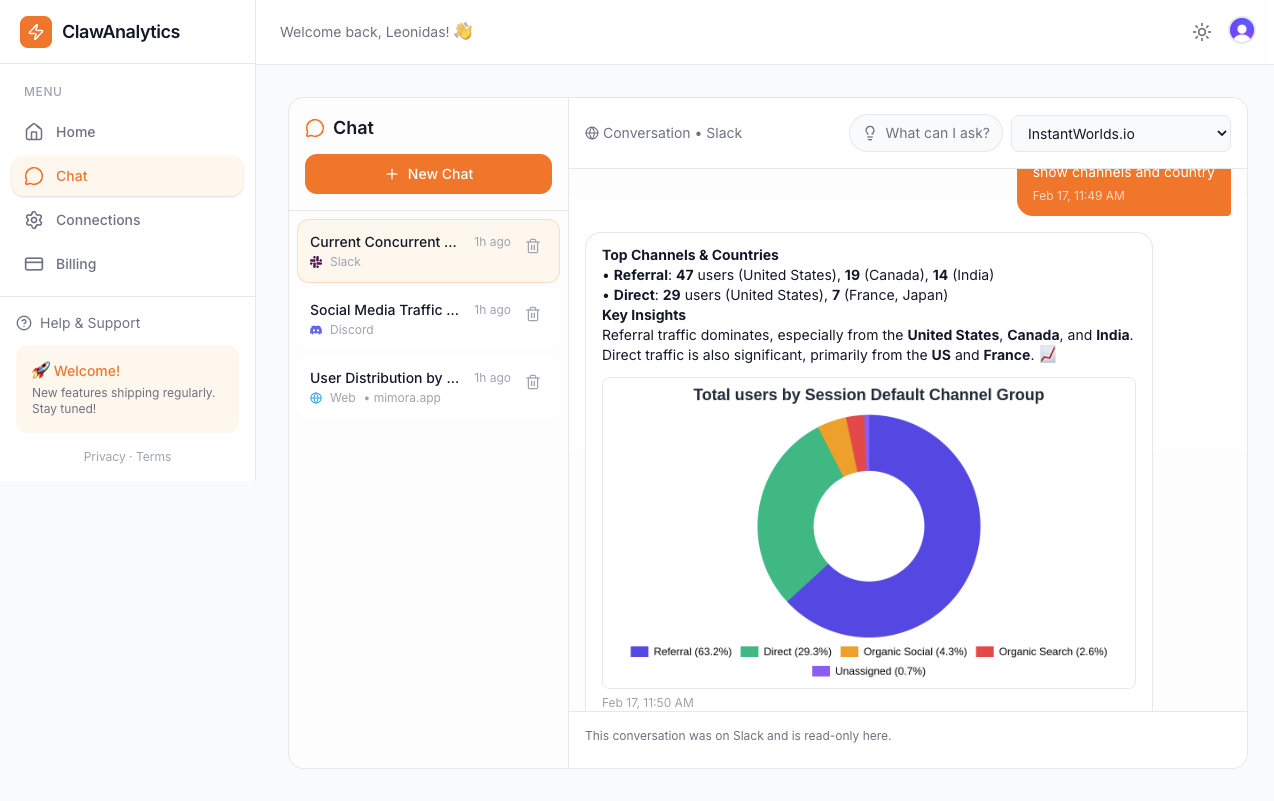
Instant responses with visualizations. Share charts with your team or export the data.

ClawAnalytics showing chart response to analytics query

See it in action

Ask a question. Get a chart. That simple.

ClawAnalytics Chat
ClawAnalytics chat interface showing a natural language analytics query with chart response

Works on web, Discord, and Slack. Also available as an MCP server for AI agents.

Leonidas Maliokas
"I used to open Google Analytics 5 times a day and still miss things. Now I get a summary every morning and ask follow-ups when something looks off. Takes 10 seconds instead of 10 minutes."

Leonidas Maliokas

Founder, Elanra Studios

🎮 5 games monitored 💼 3 businesses

Simple, honest pricing

Start free. Upgrade when you're ready.

Free

Try it out

$0 /month
  • 5 websites
  • 30 questions/month
  • Web dashboard
  • No credit card
Start Free

Website

For small businesses

$9 /month
  • 5 websites connected
  • 100 questions/month
  • Daily morning summary
  • Web dashboard + Discord
Get Started

Business

For agencies and portfolios

$79 /month
  • Unlimited websites
  • 2,000 questions/month
  • Everything in Pro
  • ✅ API access
  • ✅ MCP integration
  • ⭐ Priority support
Get Started

Stop opening dashboards.
Start asking.

Connect Google Analytics in 30 seconds. Get answers from the dashboard or Discord. Start free — no credit card needed.

Try it free — ask your first question
30-second setup Free plan available Cancel anytime

Got questions?

What is a good bounce rate for SaaS?
A good bounce rate for SaaS landing pages ranges from 25% to 55%. B2B SaaS companies typically see 25-40% bounce rates on their main pages, while B2C SaaS may see 40-55%. Rates above 60% often indicate messaging misalignment or poor page load speed.
Why does bounce rate matter for SaaS subscriptions?
High bounce rates on pricing or feature pages signal that visitors are not finding the value proposition compelling. This directly impacts free trial signups and paid conversions, making bounce rate a critical metric for SaaS growth teams.
How does bounce rate differ from exit rate in GA4?
Bounce rate measures single-page sessions where users left without any interaction. Exit rate shows the percentage of sessions that ended on a specific page. For SaaS, combining both metrics reveals where users drop off versus where they naturally finish their journey.
What tools can help SaaS teams improve bounce rate?
Google Analytics 4 provides built-in bounce rate tracking with engagement metrics. ClawAnalytics adds AI-powered insights that explain why users bounce and suggest specific fixes. Hotjar and FullStory offer session recordings that reveal user frustration points.

Related guides

More resources to help you get the most from your analytics.